
Best Graphics Card Under 40000 India 2026: RTX 5060 vs RX 9060 XT

Harsh Talreja
27 Min Read

Updated May 2026 with current Indian retail prices.

Disclosure: GamingNation.in earns a commission from purchases made via links on this page, at no extra cost to you. As an Amazon Associate I earn from qualifying purchases. Read our affiliate policy.
.gnpc{display:grid;grid-template-columns:220px 1fr;gap:22px;background:#fafefb;border:1px solid #d1fae5;border-radius:4px;padding:18px;margin:0 0 20px;align-items:start;position:relative} .gnpc::before{content:””;position:absolute;left:-1px;top:-1px;bottom:-1px;width:4px;background:#10b981;box-shadow:0 0 8px rgba(16,185,129,.35);border-radius:4px 0 0 4px} .gnpc__img{background:#fff;border:1px solid #e5e7eb;border-radius:4px;padding:10px;aspect-ratio:4/3;display:flex;align-items:center;justify-content:center;overflow:hidden} .gnpc__img img{max-width:100%;max-height:100%;height:auto;width:auto;display:block} .gnpc__body{display:flex;flex-direction:column;min-width:0} .gnpc__badge{background:#ecfdf5;color:#047857;border:1px solid #a7f3d0;font-size:10px;font-weight:700;padding:4px 10px;border-radius:3px;text-transform:uppercase;letter-spacing:.12em;align-self:flex-start;margin-bottom:10px} .gnpc__name{font-size:17px;font-weight:700;color:#0f172a;margin:0 0 12px;line-height:1.3;letter-spacing:-.005em} .gnpc__specs{display:grid;grid-template-columns:1fr 1fr;gap:6px 14px;font-size:12.5px;color:#334155;margin:0 0 14px;padding:12px 14px;background:#fff;border:1px solid #e5e7eb;border-radius:4px;line-height:1.45} .gnpc__spec{display:flex;align-items:flex-start;gap:7px} .gnpc__spec>span:first-child{flex-shrink:0;width:13px;height:13px;color:#10b981;margin-top:2px;display:inline-flex} .gnpc__spec>span:first-child svg{width:13px;height:13px} .gnpc__spec>span:last-child{flex:1;min-width:0} .gnpc__spec strong{color:#0f172a;font-weight:600} .gnpc__buyrow{display:flex;align-items:center;gap:14px;flex-wrap:wrap} .gnpc__price{font-size:24px;font-weight:700;color:#047857;letter-spacing:-.01em;font-family:’SF Mono’,Menlo,monospace} .gnpc a.gnpc__cta,a.gnpc__cta{background:#f59e0b!important;background-image:linear-gradient(180deg,#fbbf24 0%,#f59e0b 55%,#d97706 100%)!important;color:#0f172a!important;font-weight:800;font-size:13px;padding:13px 22px;border-radius:4px;text-decoration:none!important;white-space:nowrap;display:inline-block;text-transform:uppercase;letter-spacing:.06em;border:1px solid #b45309!important;box-shadow:0 1px 0 rgba(255,255,255,.4) inset,0 2px 4px rgba(0,0,0,.08)!important;min-height:48px;line-height:22px;text-align:center;transition:filter .12s ease} .gnpc a.gnpc__cta:hover,a.gnpc__cta:hover{filter:brightness(1.04);color:#0f172a!important;text-decoration:none!important} .gnpc__trust{margin:8px 0 0;font-size:11.5px;color:#64748b;line-height:1.5;display:flex;flex-wrap:wrap;gap:10px;align-items:center} .gnpc__trust span{display:inline-flex;align-items:center;gap:5px} .gnpc__trust span::before{content:””;width:5px;height:5px;border-radius:50%;background:#10b981;flex-shrink:0} .gnpc–top{border-color:#10b981;border-width:2px;background:#f0fdf4;box-shadow:0 4px 18px rgba(16,185,129,.13);padding-top:24px} .gnpc–top::before{box-shadow:0 0 12px rgba(16,185,129,.5)} .gnpc__ribbon{position:absolute;top:-11px;left:18px;background:#f59e0b;color:#fff;font-weight:800;font-size:10px;padding:5px 12px;border-radius:3px;text-transform:uppercase;letter-spacing:.14em;box-shadow:0 2px 6px rgba(245,158,11,.4);z-index:2;line-height:1.3} .gnverd{display:grid;grid-template-columns:1fr 1fr;gap:10px;margin:0 0 22px;font-size:13.5px} .gnverd>div{display:flex;align-items:flex-start;gap:10px;padding:12px 14px;background:#fff;border:1px solid #e5e7eb;border-radius:4px;line-height:1.5;color:#334155} .gnverd__icon{flex-shrink:0;width:18px;height:18px;border-radius:3px;display:flex;align-items:center;justify-content:center;font-size:11px;font-weight:800;margin-top:1px} .gnverd__icon–y{background:#ecfdf5;color:#047857;border:1px solid #a7f3d0} .gnverd__icon–n{background:#fff1f2;color:#be123c;border:1px solid #fecdd3} .gnverd b{font-weight:700;color:#0f172a;letter-spacing:.01em;margin-right:4px} .gnpros{display:grid;grid-template-columns:1fr 1fr;gap:14px;margin:22px 0} .gnpros>div{border:1px solid #e5e7eb;border-radius:4px;padding:14px 16px;background:#fff} .gnpros__head{display:flex;align-items:center;gap:10px;margin:0 0 10px} .gnpros__bar{width:4px;height:18px;border-radius:2px;flex-shrink:0} .gnpros__bar–y{background:#10b981} .gnpros__bar–n{background:#f43f5e} .gnpros__label{margin:0;font-weight:700;font-size:16px;letter-spacing:-.005em;padding:0;border:0;line-height:1.2} .gnpros__label.y{color:#047857} .gnpros__label.n{color:#be123c} .gnpros ul{margin:0;padding:0;list-style:none;font-size:13.5px;line-height:1.55;color:#334155} .gnpros li{padding-left:16px;position:relative;margin-bottom:5px} .gnpros li::before{content:””;position:absolute;left:0;top:8px;width:6px;height:6px;border-radius:50%} .gnpros .y li::before{background:#10b981} .gnpros .n li::before{background:#f43f5e} .gn-tbl-wrap{overflow-x:auto;-webkit-overflow-scrolling:touch;margin:0 0 20px} .gn-tbl{width:100%;border-collapse:collapse;font-size:13px;line-height:1.4} .gn-tbl th{background:#f0fdf4;color:#047857;font-weight:700;font-size:11px;text-transform:uppercase;letter-spacing:.1em;padding:10px 12px;border-bottom:2px solid #d1fae5;text-align:left;white-space:nowrap} .gn-tbl td{padding:10px 12px;border-bottom:1px solid #f1f5f9;vertical-align:top;color:#334155} .gn-tbl tr:last-child td{border-bottom:0} .gn-tbl tr.gnt-top td{background:#f0fdf4;font-weight:600} .gnt-label{font-size:11px;font-weight:700;color:#047857;white-space:nowrap} .gnt-name{font-weight:600;color:#0f172a} .gnt-num{font-family:’SF Mono’,Menlo,monospace;font-size:12px;color:#475569;white-space:nowrap} .gn-tbl-buy{background:#f59e0b!important;background-image:linear-gradient(180deg,#fbbf24 0%,#f59e0b 55%,#d97706 100%)!important;color:#0f172a!important;font-weight:800;font-size:10.5px;padding:7px 10px;border-radius:3px;text-decoration:none!important;white-space:nowrap;border:1px solid #b45309!important;text-transform:uppercase;letter-spacing:.05em;display:inline-block;line-height:1.2} .gn-tbl-buy:hover{filter:brightness(1.04);color:#0f172a!important;text-decoration:none!important} .gn-glance{border:1px solid #d1fae5;border-radius:6px;background:#fafefb;padding:0;margin:0 0 26px;overflow:hidden} .gn-glance__head{padding:16px 18px 14px;border-bottom:1px solid #eef7f1} .gn-glance__label{display:inline-block;font-size:10.5px;font-weight:800;color:#047857;text-transform:uppercase;letter-spacing:.14em;margin:0 0 8px} .gn-glance__tldr{margin:0 0 10px;font-size:15px;line-height:1.6;color:#0f172a} .gn-glance__byline{margin:0;font-size:12px;color:#64748b;display:flex;flex-wrap:wrap;gap:8px;align-items:center;line-height:1.5} .gn-glance__ht{display:inline-flex;align-items:center;gap:6px;font-weight:600;color:#334155} .gn-glance__ht-initials{display:inline-flex;align-items:center;justify-content:center;width:20px;height:20px;border-radius:50%;background:#10b981;color:#fff;font-size:9.5px;font-weight:800} .gn-glance .dot{width:3px;height:3px;border-radius:50%;background:#cbd5e1} .gn-glance__facts{padding:14px 18px 16px;background:#fff} .gn-glance__facts-lbl{margin:0 0 8px;font-size:10.5px;font-weight:800;color:#047857;text-transform:uppercase;letter-spacing:.12em} .gn-keyfacts{font-size:13.5px;line-height:1.6;color:#334155} .gn-glance__facts ul{margin:0;padding:0 0 0 18px} .gn-glance__facts li{margin-bottom:6px} @media (max-width:760px){.gnpc{grid-template-columns:1fr!important;gap:16px;padding:16px}.gnpc–top{padding-top:22px}.gnpc__img{max-width:320px;margin:0 auto;width:100%}.gnpc__specs{grid-template-columns:1fr!important}.gnpc__price{font-size:22px}.gnverd,.gnpros{grid-template-columns:1fr!important}.gnpc__buyrow{justify-content:space-between;gap:10px}.gnpc__cta{flex:1;text-align:center}} @media (max-width:420px){.gnpc__buyrow{flex-direction:column;align-items:stretch}.gnpc__cta{width:100%;padding:14px 16px}.gnpc__trust{flex-direction:column;align-items:flex-start;gap:4px}}

Rs 40,000 is the budget where a graphics card stops being a 1080p machine and starts becoming a 1440p one. This is where the current Blackwell and RDNA 4 cards land, the RTX 5060 and RX 9060 XT, alongside cheaper RTX 5050 options, and the difference between them is real. I checked every price and stock level live on Amazon.in, kept only cards genuinely in stock between Rs 30,000 and Rs 40,000, and here are the six worth buying right now, with honest advice on resolution, VRAM and which brand to pick.

At a glance · May 2026

My pick is the MSI RTX 5060 Ventus 2X OC at Rs 38,000, the card that opens up real 1440p with DLSS 4 and fast GDDR7. For pure raster value, the PowerColor RX 9060 XT at Rs 37,369 is the AMD pick. On the lowest budget, the GIGABYTE RTX 5050 at Rs 34,300 still brings DLSS 4. Six cards, prices and stock checked live on Amazon.in in May 2026.

Before you buy a GPU here

  • At Rs 40,000 you are buying into 1440p. At Rs 30,000 the same class of card is really a 1080p buy.
  • Every card here ships with 8GB VRAM except where noted, which is fine for 1080p but tight for maxed 1440p textures.
  • NVIDIA wins on DLSS 4 and ray tracing. AMD wins on raw native frames per rupee. Pick the trade you care about.
The 6 best graphics cards under Rs 40,000
Top Pick
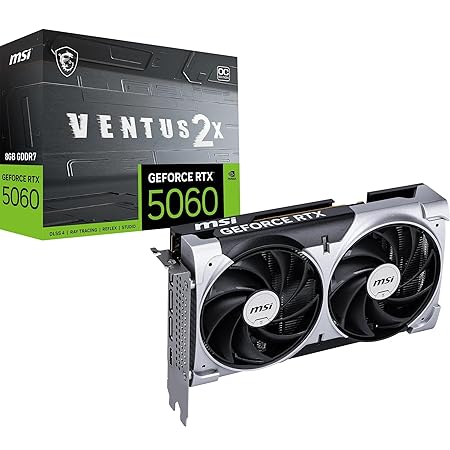
MSI GeForce RTX 5060 Ventus 2X OC 8GB graphics card
Best Overall

MSI GeForce RTX 5060 Ventus 2X OC 8GB

Price: Rs 38,000 GPU chip: GeForce RTX 5060 (Blackwell) VRAM: 8GB GDDR7 Memory: 128-bit, 28 Gbps TDP: See listing, ~145W class Best resolution: 1440p high, 1080p ultra

Price as of June 2026Confirm live on Amazon.inBest 1440p pick

Buy it You want the strongest all round card in this band. The RTX 5060 brings GDDR7 memory and DLSS 4 with Multi Frame Generation, so it pushes 1440p in most titles and runs 1080p with frames to spare.
Skip it You will only ever play at 1080p high refresh esports. A cheaper RTX 5050 saves you Rs 3,000 plus and still buries those games.

The MSI RTX 5060 Ventus 2X OC is the card I would hand most people spending close to Rs 40,000. It sits on NVIDIA Blackwell, pairs 8GB of fast GDDR7 with a 128-bit bus, and unlocks DLSS 4 with Multi Frame Generation, the feature that lets it insert extra AI frames and lift smoothness well past what the raw silicon does alone. In practice that means 1440p stays playable in heavy single player games and 1080p feels effortless.

The Ventus 2X cooler is a compact twin fan design that keeps the card quiet and short enough for most mid tower cabinets. At Rs 38,000 it is not the cheapest option here, but it is the one that ages best thanks to DLSS 4 and the GDDR7 bandwidth, and it is the safest pick if you want to stop thinking about your GPU for a few years.

What works

  • Newest Blackwell architecture
  • DLSS 4 with Multi Frame Generation
  • Fast 8GB GDDR7 memory
  • Compact, quiet twin fan cooler
  • Genuine 1440p capability

What is bad

  • 8GB VRAM is the ceiling, not generous
  • Costs more than the RTX 5050 picks
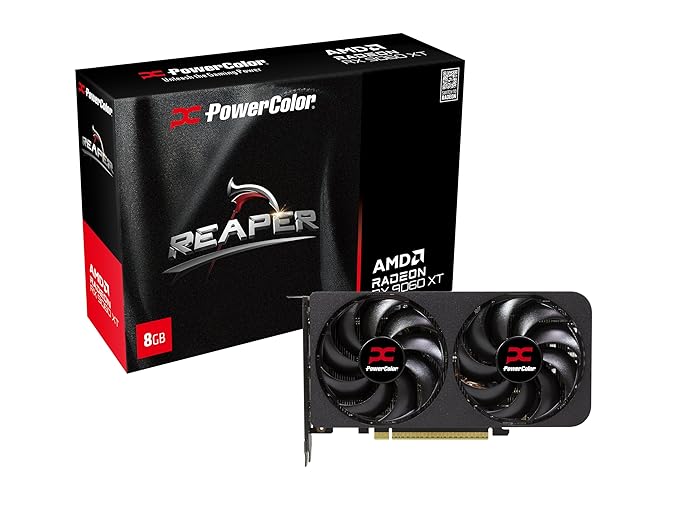
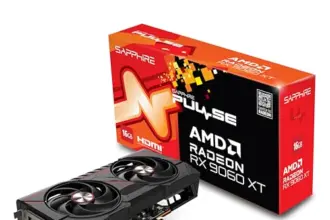
PowerColor Radeon RX 9060 XT 8GB graphics card
Best AMD

PowerColor Radeon RX 9060 XT 8GB

Price: Rs 37,369 GPU chip: Radeon RX 9060 XT (RDNA 4) VRAM: 8GB GDDR6 Memory: See listing TDP: See listing Best resolution: 1440p high, 1080p ultra

Price as of June 2026Confirm live on Amazon.inBest raster value

Buy it You care most about raw frames per rupee and you run FSR rather than DLSS. The RX 9060 XT on RDNA 4 trades blows with the RTX 5060 in pure rasterisation and usually costs a little less.
Skip it You specifically want DLSS 4 Multi Frame Generation or the best ray tracing. NVIDIA still leads on both fronts.

The PowerColor RX 9060 XT is AMD’s answer in this band and it makes a strong case on value. Built on the newer RDNA 4 architecture, it delivers rasterisation performance right alongside the RTX 5060 while typically undercutting it on price, and it supports FSR upscaling plus AMD’s frame generation to stretch frame rates further. For pure native resolution gaming it is one of the best frames per rupee buys here.

PowerColor is a long standing AMD board partner, so the cooler and build are dependable rather than flashy. The catch is the same 8GB VRAM ceiling as the NVIDIA cards, and AMD’s ray tracing and upscaling, while much improved on RDNA 4, still trail NVIDIA’s. If you weigh native performance and price over the NVIDIA software stack, this is the AMD pick to beat.

What works

  • RDNA 4, strong native rasterisation
  • Usually cheaper than the RTX 5060
  • FSR and AMD frame generation supported
  • Great frames per rupee at 1080p and 1440p

What is bad

  • 8GB VRAM ceiling like the rivals
  • Ray tracing still behind NVIDIA
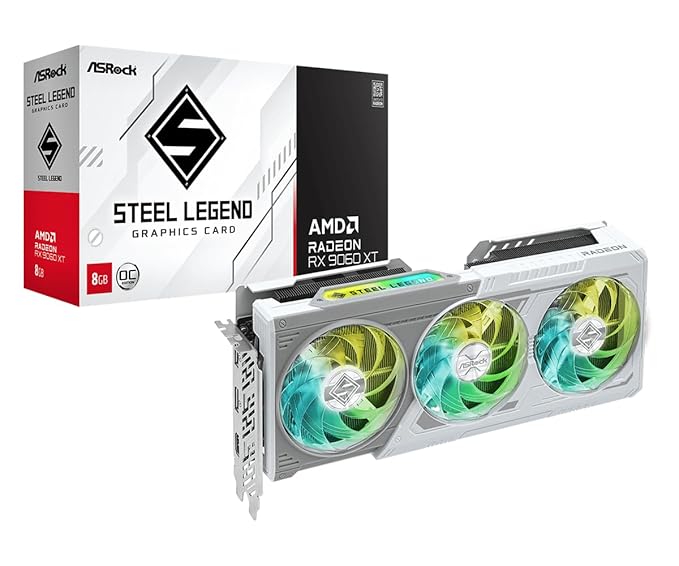
ASRock Radeon RX 9060 XT Steel Legend OC 8GB graphics card
Best AMD Build

ASRock Radeon RX 9060 XT Steel Legend OC 8GB

Price: Rs 38,809 GPU chip: Radeon RX 9060 XT (RDNA 4) VRAM: 8GB GDDR6 Memory: See listing TDP: See listing, factory OC Best resolution: 1440p high, 1080p ultra

Price as of June 2026Confirm live on Amazon.inPremium AMD cooler

Buy it You want the same RX 9060 XT chip but with a beefier cooler and a factory overclock. The Steel Legend line is ASRock’s premium board, with a stronger heatsink and clean white styling.
Skip it You are watching every rupee. The plainer PowerColor 9060 XT gives near identical gaming for a bit less.

The ASRock RX 9060 XT Steel Legend is the same RDNA 4 chip as the PowerColor card dressed in ASRock’s premium clothing. The Steel Legend line gets a larger triple slot heatsink, a factory overclock and the clean silver and white look that suits a themed build, so it runs a touch cooler and quieter under load and has headroom for sustained boost clocks.

You pay a small premium over the plain PowerColor card for that cooler and the styling, which is worth it if your build is on display or your cabinet airflow is average. Gaming performance is effectively identical to the other 9060 XT, so treat this as the choice for buyers who want the nicer board rather than the absolute cheapest entry to RDNA 4.

What works

  • Larger triple slot cooler, runs cool
  • Factory overclock out of the box
  • Clean Steel Legend white styling
  • Same strong RDNA 4 raster as the cheaper 9060 XT

What is bad

  • Costs more than the base 9060 XT
  • Still the 8GB VRAM ceiling
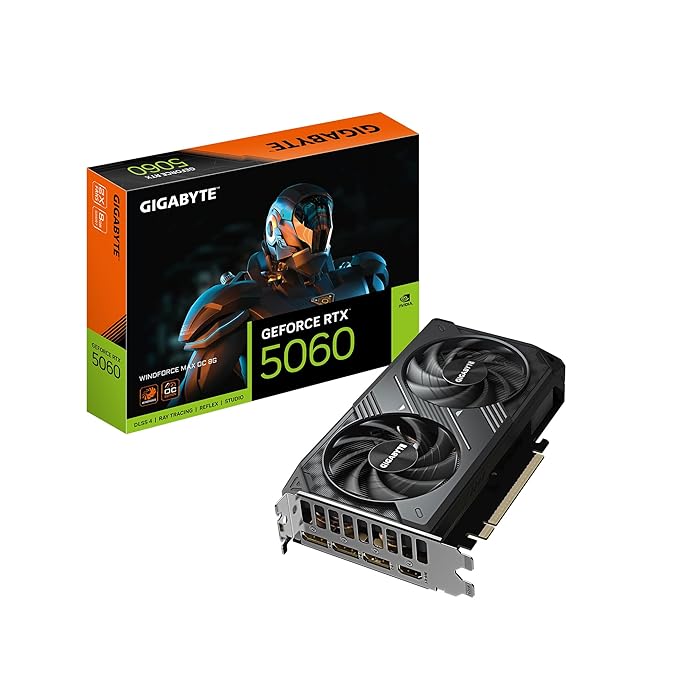
GIGABYTE GeForce RTX 5060 WINDFORCE MAX OC 8GB graphics card
Best Cooling

GIGABYTE GeForce RTX 5060 WINDFORCE MAX OC 8GB

Price: Rs 39,500 GPU chip: GeForce RTX 5060 (Blackwell) VRAM: 8GB GDDR7 Memory: 128-bit TDP: See listing, factory OC Best resolution: 1440p high, 1080p ultra

Price as of June 2026Confirm live on Amazon.inTriple fan WINDFORCE

Buy it You want the RTX 5060 with the strongest cooler in the band and a factory overclock. The WINDFORCE MAX setup keeps clocks high and noise low even in a warm room.
Skip it You want to spend as little as possible on an RTX 5060. The MSI Ventus 2X gives the same chip for Rs 1,500 less.

The GIGABYTE RTX 5060 WINDFORCE MAX OC is the cooling champion of this list. It wraps the same Blackwell RTX 5060 and 8GB GDDR7 in GIGABYTE’s larger WINDFORCE cooler with multiple fans and a thicker heatsink, plus a factory overclock, so it holds its boost clock for longer and stays quiet during long sessions. In Indian summers, where ambient temperatures punish small coolers, that thermal headroom matters.

At Rs 39,500 it is the priciest card here and it bumps right against the Rs 40,000 ceiling, so you are paying for cooling and OC headroom rather than a faster chip. If your cabinet airflow is poor or you simply want the coolest, quietest RTX 5060, this is the one. If budget is tight, the cheaper Ventus 2X gives the same frames.

What works

  • Large WINDFORCE cooler, excellent thermals
  • Factory overclock, holds boost longer
  • Same DLSS 4 and GDDR7 as other RTX 5060
  • Quiet under sustained load

What is bad

  • Most expensive card here
  • Physically large, check cabinet clearance
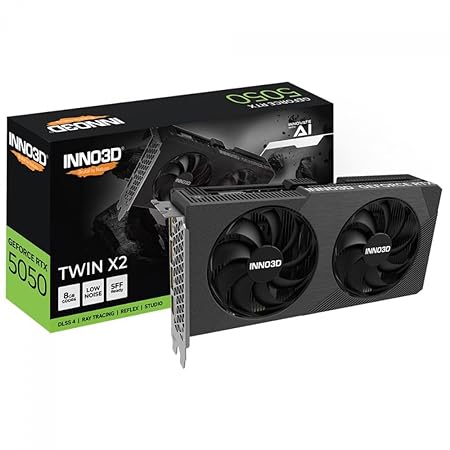
INNO3D GeForce RTX 5050 Twin X2 8GB graphics card
Best Compact

INNO3D GeForce RTX 5050 Twin X2 8GB

Price: Rs 34,739 GPU chip: GeForce RTX 5050 (Blackwell) VRAM: 8GB GDDR6 Memory: 128-bit, PCIe Gen 5 TDP: See listing, ~130W class Best resolution: 1080p ultra, 1440p medium

Price as of June 2026Confirm live on Amazon.inShort dual fan card

Buy it You want the cheapest way into Blackwell and DLSS 4, in a short card that fits compact cabinets. The RTX 5050 Twin X2 is a tidy entry point that still crushes 1080p.
Skip it You want comfortable 1440p in demanding games. The RTX 5060 and RX 9060 XT are clearly stronger for that.

The INNO3D RTX 5050 Twin X2 is the value entry to the new Blackwell generation. It is the cheapest card here that still gives you DLSS 4 with Multi Frame Generation, runs on a PCIe Gen 5 interface and packs 8GB GDDR6, and its short dual fan design slips into small form factor and budget cabinets that cannot take a long triple fan board.

At Rs 34,739 it is built for 1080p, where it runs ultra settings comfortably and uses DLSS 4 to reach high refresh rates. It will touch 1440p in lighter games but is not the card for maxing out demanding titles at that resolution. If your priority is the lowest price with modern features, or a build with tight space, the Twin X2 earns its place.

What works

  • Cheapest Blackwell card with DLSS 4
  • Short, fits compact cabinets
  • 8GB GDDR6 on PCIe Gen 5
  • Excellent at 1080p ultra

What is bad

  • Weaker than the RTX 5060 at 1440p
  • 8GB VRAM, watch heavy texture packs
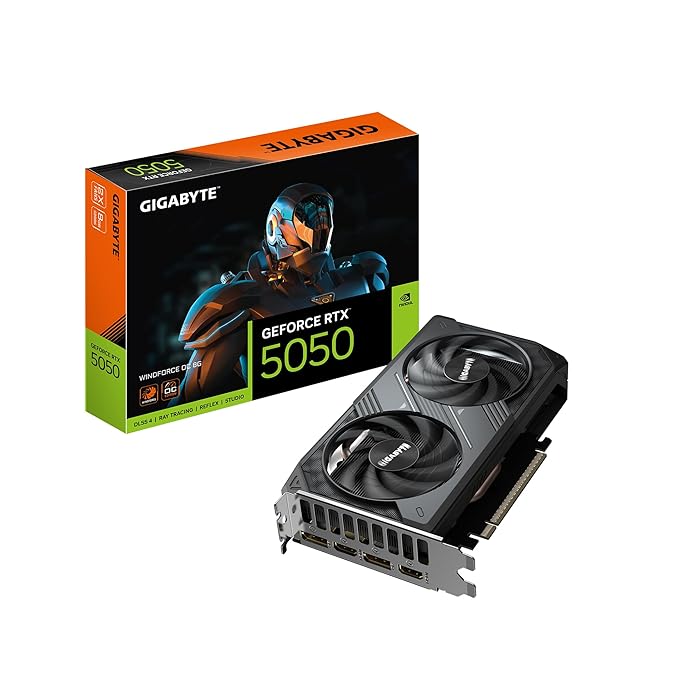
GIGABYTE GeForce RTX 5050 WINDFORCE OC 8GB graphics card
Best Value

GIGABYTE GeForce RTX 5050 WINDFORCE OC 8GB

Price: Rs 34,300 GPU chip: GeForce RTX 5050 (Blackwell) VRAM: 8GB GDDR6 Memory: See listing, PCIe Gen 5 TDP: See listing, factory OC Best resolution: 1080p ultra, 1440p medium

Price as of June 2026Confirm live on Amazon.inCheapest DLSS 4 card

Buy it You want the lowest price in this guide while still getting DLSS 4 and a proper dual fan cooler. The WINDFORCE OC is the cheapest card here and a clean 1080p machine.
Skip it You can stretch to Rs 38,000. The RTX 5060 or RX 9060 XT is a real step up for 1440p that is worth the extra.

The GIGABYTE RTX 5050 WINDFORCE OC is the price floor of this guide at Rs 34,300, and it shows that even the bottom of the Rs 30,000 to 40,000 band now buys a current generation Blackwell card. You get DLSS 4 with Multi Frame Generation, 8GB GDDR6, a factory overclock and GIGABYTE’s WINDFORCE dual fan cooler that runs quiet for the class.

This is a 1080p card first and foremost, where it handles ultra settings and uses DLSS 4 to hit high frame rates in modern titles. It is the smart buy if you want maximum value and modern features without spending close to Rs 40,000. If you have the room in your budget, though, the jump to an RTX 5060 buys real 1440p ability that this card cannot match.

What works

  • Cheapest card in this guide
  • DLSS 4 with Multi Frame Generation
  • Factory overclock, quiet WINDFORCE cooler
  • Strong 1080p value

What is bad

  • Entry tier, weakest 1440p here
  • 8GB VRAM ceiling

All six graphics cards compared

Best forGraphics cardPriceGPU chipVRAMBuy
OverallMSI GeForce RTX 5060 Ventus 2X OC 8GBRs 38,000GeForce RTX 50608GB GDDR7Amazon
AMDPowerColor Radeon RX 9060 XT 8GBRs 37,369Radeon RX 9060 XT8GB GDDR6Amazon
AMD BuildASRock Radeon RX 9060 XT Steel Legend OC 8GBRs 38,809Radeon RX 9060 XT8GB GDDR6Amazon
CoolingGIGABYTE GeForce RTX 5060 WINDFORCE MAX OC 8GBRs 39,500GeForce RTX 50608GB GDDR7Amazon
CompactINNO3D GeForce RTX 5050 Twin X2 8GBRs 34,739GeForce RTX 50508GB GDDR6Amazon
ValueGIGABYTE GeForce RTX 5050 WINDFORCE OC 8GBRs 34,300GeForce RTX 50508GB GDDR6Amazon

The jump from Rs 30,000 to Rs 40,000 in GPUs

Advertisement

The extra Rs 10,000 between the two budgets buys more than it looks. At Rs 30,000 you are mostly choosing among last generation cards like the RX 7600 and RX 7600 XT that are tuned for 1080p, as I covered in my best graphics card under Rs 30,000 guide. At Rs 40,000 the whole shelf shifts to the current generation, the Blackwell RTX 5050 and 5060 and the RDNA 4 RX 9060 XT, which means newer architectures, DLSS 4 with Multi Frame Generation on the NVIDIA side, and the headroom to push past 1080p. The money does not just buy a faster version of the same thing, it buys a newer class of card and a real step up in resolution and longevity.

Best resolution to target at Rs 40,000

The honest target at this budget is 1440p with sensible settings, not maxed everything. The RTX 5060 and RX 9060 XT both handle 1440p in most games once you lean on DLSS 4 or FSR, which is exactly why they justify the spend over a Rs 30,000 card that is happiest at 1080p. The two RTX 5050 options are a step below, built for 1080p ultra with 1440p reserved for lighter titles. If you already own a 1440p monitor, buy the RTX 5060 or RX 9060 XT. If you are on 1080p high refresh and want maximum frames in esports, even the RTX 5050 will not break a sweat, and you can pocket the difference.

VRAM and future-proofing

Advertisement

Here is the uncomfortable truth at this price, almost every card in this band ships with 8GB of VRAM, and 8GB is starting to feel tight at 1440p in the newest games with high texture settings. It is perfectly fine for 1080p and for 1440p with textures dialled to high rather than ultra, but if you plan to keep the card for four or five years and chase ultra textures, that 8GB is the limit you will hit first, before the chip itself runs out of muscle. There is no 12GB or 16GB option that is both current generation and genuinely in stock under Rs 40,000 right now, so the practical move is to accept 8GB, play at 1440p high rather than ultra, and let DLSS 4 or FSR do the heavy lifting.

DLSS vs FSR, NVIDIA vs AMD upscaling

This is the real NVIDIA versus AMD decision at Rs 40,000. NVIDIA cards run DLSS 4, and its Multi Frame Generation can insert several AI frames between rendered ones, which lifts smoothness dramatically in supported games, and DLSS image quality is still the benchmark. AMD counters with FSR and its own frame generation, which has improved a lot on RDNA 4 and is open, so it works on more hardware, but it generally trails DLSS on fine image quality. My guidance, if you play the latest AAA titles and want the cleanest upscaled image plus the best ray tracing, go NVIDIA with the RTX 5060. If you want the most native frames for your money and are happy with FSR, the RX 9060 XT is the value play.

Is a Rs 40,000 GPU worth it

For a 1440p gamer, yes, clearly. This is the budget where a single GPU upgrade changes the resolution you can comfortably play at, and the current generation cards here will stay relevant for years thanks to DLSS 4 and FSR. For a strict 1080p esports player it is less obvious, a Rs 30,000 card already maxes those games, so the extra spend mostly buys future headroom rather than frames you will see today. The other thing worth saying, a GPU is only as good as the system around it, so make sure your power supply and CPU are not the bottleneck. If you are building from scratch, my Rs 1,00,000 PC build and Rs 75,000 PC build guides show exactly which parts pair well with a card in this class.

Frequently asked questions

Q.Which is the best graphics card under Rs 40,000 in India?

For most people the MSI RTX 5060 Ventus 2X OC at around Rs 38,000, because it brings the newest Blackwell architecture, DLSS 4 with Multi Frame Generation and fast GDDR7, which together make real 1440p gaming possible. If you prefer AMD and value native frames per rupee, the PowerColor RX 9060 XT at Rs 37,369 is the pick instead.

Q.Can a Rs 40,000 graphics card run games at 1440p?

Yes, the RTX 5060 and RX 9060 XT both handle 1440p in most games once you use DLSS 4 or FSR upscaling, which is the main reason to spend this much over a Rs 30,000 card. The cheaper RTX 5050 cards are better treated as 1080p ultra machines that can reach 1440p only in lighter titles.

Q.Is 8GB of VRAM enough for gaming in 2026?

For 1080p, yes, comfortably. For 1440p it is enough if you keep textures on high rather than ultra in the newest games, but 8GB is the first ceiling you will hit if you plan to max textures for years. Sadly there is no current generation 12GB or 16GB card reliably in stock under Rs 40,000 right now, so 8GB with smart settings is the realistic plan at this budget.

Q.Should I buy NVIDIA or AMD at this price?

Buy NVIDIA, the RTX 5060, if you want the best upscaling with DLSS 4, the strongest ray tracing and the cleanest image. Buy AMD, the RX 9060 XT, if you want the most native frames for your money and are happy using FSR. Both are good on RDNA 4 and Blackwell, so choose the trade off that matches how you play.

Q.Are these graphics card prices accurate?

These were checked live on Amazon.in in May 2026, and only cards that were genuinely in stock between Rs 30,000 and Rs 40,000 made the list. GPU prices and stock move fast though, so treat each number as a snapshot and open the listing to confirm what it costs and whether it is available today.

The verdict

The clear story at Rs 40,000 is that you are buying a 1440p capable card, and the choice comes down to NVIDIA software or AMD value. For the best all round buy I would take the MSI RTX 5060 Ventus 2X OC at Rs 38,000, my overall pick, for its DLSS 4 and GDDR7. If you want AMD and the most native frames per rupee, the PowerColor RX 9060 XT is the call, and on a tighter budget the GIGABYTE RTX 5050 still gives you DLSS 4 for Rs 34,300. All six are genuinely in stock and in band. Shopping a different budget? See the best graphics card under Rs 30,000, or plan the whole machine with the Rs 1,00,000 PC build guide.

Advertisement
HT

Harsh Talreja

I have spent years buying, returning and recommending gaming gear in India, where the price, the warranty and the dead pixel policy matter as much as the spec sheet. Every pick here is checked against live Amazon.in listings and what actually survives an Indian RMA.

Editor at GamingNation.in, Mumbai. More from Harsh

Share This Article
Follow:
Harsh Talreja edits Gaming Nation from a Mumbai bedroom desk and a Bangalore hotel desk on alternate months. He has been writing about PC hardware, gaming peripherals and Indian gaming cafes for 6 years, with hands-on time on every major PC component category sold in India under Rs 2,00,000 (RTX 3050 to RTX 4070 Super, Ryzen 5 5600 to Ryzen 7 7700X, every B550 and B650 mainstream board, 144Hz IPS to 240Hz OLED, Razer DeathAdder to Logitech G502 Hero). He has visited and benchmarked over 18 gaming cafes across Mumbai, Bangalore, Pune, Delhi, Hyderabad, Chennai, Kolkata and Amritsar. Plays BGMI at Crown tier, Valorant at Diamond, daily-drives a 5800X3D plus RX 7600 build at home. Outside Gaming Nation, Harsh works as an SEO partner for Indian startups (he can be reached on LinkedIn for that work). All Indian retail prices on this site are checked monthly against Amazon.in and Flipkart, all hardware claims are checked against RTINGS, Tom's Hardware, NotebookCheck, and Hardware Unboxed where applicable.