
Updated May 2026 with current Indian retail prices.
Rs 30,000 is the budget where a graphics card stops being a compromise and starts running modern games properly at 1080p. This is the band of the RTX 3050 and the AMD RX 7600, the entry tier of real gaming GPUs in India. I checked every price, every spec and the stock status live on Amazon.in this month, because GPU prices here swing fast. These are the five worth buying between Rs 20,000 and Rs 30,000 in 2026, and how to pick between NVIDIA features and AMD frames. For higher-tier cards, see the best graphics cards under Rs 60,000.
My pick is the ASUS Dual RX 7600 EVO 8GB at Rs 27,235, the fastest card in this band with the 8GB of memory new games now expect. If you want NVIDIA, DLSS and ray tracing, take the 8GB Gigabyte RTX 3050, not the 6GB version. Five cards, all prices and stock checked live on Amazon.in in May 2026.
Know this before you buy a GPU at Rs 30,000
- 8GB of VRAM is the line to watch in 2026. Several 6GB cards in this band run short of memory in the newest AAA games.
- This is firmly a 1080p tier. Aim for high to ultra at 1080p, not 1440p, except on the RX 7600 which stretches a little further.
- The cheapest 3050s draw only 70W and run off the slot with no power cable, so they drop into almost any prebuilt without a PSU upgrade.
The 5 best graphics cards under Rs 30,000 in India
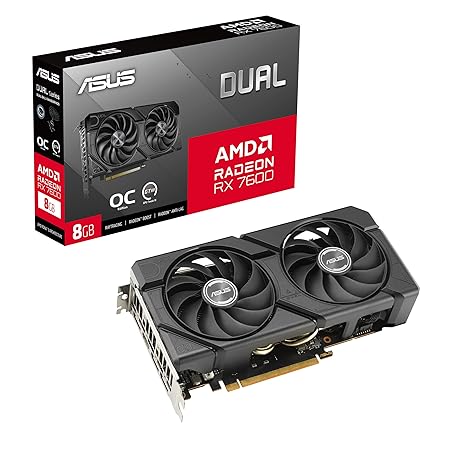
ASUS Dual Radeon RX 7600 EVO OC 8GB
Price as of May 2026Confirm live on Amazon.inStrongest raster here
The ASUS Dual RX 7600 EVO is the card I would hand to most people spending close to Rs 30,000. In pure rasterised performance, the kind that decides your frame counter in the games you actually play, it is comfortably ahead of every RTX 3050 here. It runs new titles at 1080p with the settings cranked up and has the headroom to drop into 1440p at medium where the 3050 starts to choke.
The 8GB of GDDR6 is the part that matters most for a 2026 buyer. A lot of recent games now want more than 6GB at high textures, and that is exactly where the cheaper 6GB 3050s stumble. The trade is power and ray tracing. At 165W it needs a real 8-pin connector and a 500W supply, and AMD ray tracing is weaker than NVIDIA, so if RT is your reason to buy, weigh that. For everyone chasing the smoothest 1080p experience, this is the pick.
What works
- Fastest card here in real games
- 8GB VRAM ages better than 6GB
- Handles 1080p ultra with room for 1440p medium
- Cool, quiet ASUS Dual cooler
What is bad
- Ray tracing trails NVIDIA
- 165W needs an 8-pin and 500W PSU
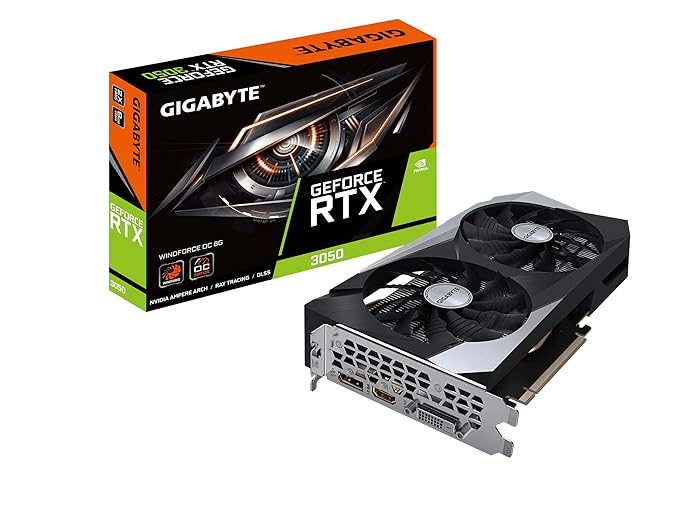
GIGABYTE GeForce RTX 3050 WINDFORCE OC 8G
Price as of May 2026Confirm live on Amazon.in8GB plus DLSS
If you specifically want an NVIDIA card at this budget, buy the 8GB version of the RTX 3050, not the 6GB one, and this Gigabyte WINDFORCE is a clean example. The wider 128-bit bus and the full 8GB of memory put real distance between it and the cut-down 6GB 3050s that fill this band. You get DLSS to claw back frames in supported games and the better ray tracing NVIDIA is known for.
It sits at Rs 28,580, near the top of our range, so you are paying for the brand and the software stack rather than chart-topping raw speed. The RX 7600 is the faster card in plain rasterisation for a little less money. But if you value DLSS, NVENC for streaming and recording, or simply trust the green team, this is the sensible NVIDIA choice here and it will hold 1080p ultra in most games.
What works
- Full 8GB and 128-bit bus, not the 6GB cut
- DLSS and stronger ray tracing
- Great for streaming via NVENC
- Cool WINDFORCE 2X cooler with backplate
What is bad
- Pricey for a 3050
- Slower than the RX 7600 in raw raster
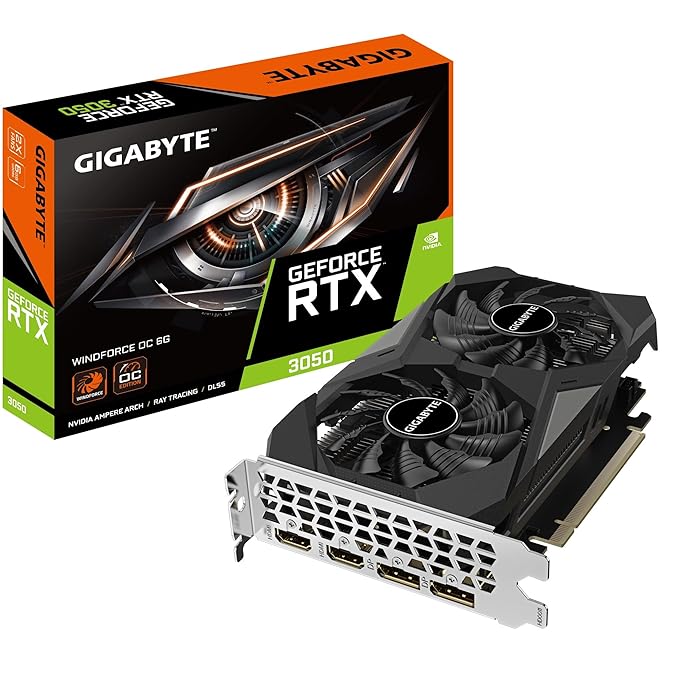
GIGABYTE GeForce RTX 3050 WINDFORCE OC 6G
Price as of May 2026Confirm live on Amazon.inCheapest card here
This is the entry point of the whole band at Rs 20,140, and its trick is efficiency. The 6GB WINDFORCE 3050 draws only about 70W, which means it runs entirely off the PCIe slot with no extra power connector. Slot it into almost any prebuilt or older system and it just works, no PSU upgrade, no spare 8-pin needed. That makes it the easiest upgrade on this list.
You still get DLSS and ray tracing cores, so esports and most current games run well at 1080p with sensible settings. The honest limit is the 6GB of memory on a narrow 96-bit bus. Push the very latest AAA titles to high textures and you will hit that wall and have to dial back. For Valorant, GTA V, Fortnite and the huge library of games that do not need more, it is a genuine bargain.
What works
- Cheapest card in this guide
- 70W, runs off the slot, no power cable
- Easy drop-in upgrade for prebuilts
- DLSS and ray tracing included
What is bad
- 6GB is tight for new AAA games
- Narrow 96-bit memory bus
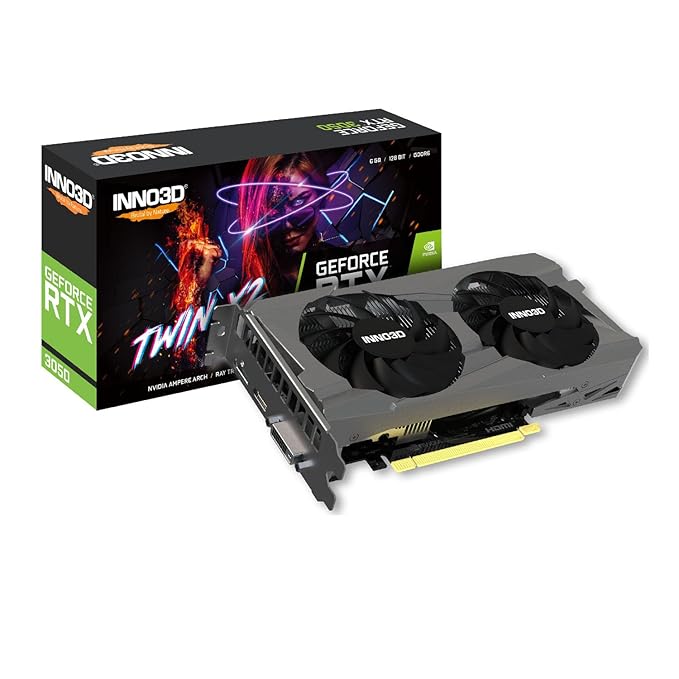
INNO3D GeForce RTX 3050 Twin X2 V2 6GB
Price as of May 2026Confirm live on Amazon.in220mm, fits small cases
The Inno3D Twin X2 is the 6GB RTX 3050 to pick when space and clearance matter. At 220mm long with a two-slot dual-fan cooler, it fits into compact mid-towers and tidy builds that cannot take the chunkier cards in this guide. Like the Gigabyte 6G it sips just 70W, so it runs off the slot with no extra power cable and asks nothing special of your supply.
Performance sits right alongside the other 6GB 3050s, so this is a 1080p high card with DLSS and ray tracing for the lighter games. The reason to choose it over the cheaper Gigabyte is purely fit and finish in a small case. If you have the room, save the money and buy the Gigabyte. If you are squeezing a GPU into a cramped build, the extra spend here buys you peace of mind on clearance.
What works
- Short 220mm card for compact builds
- 70W, no power connector needed
- Cool twin-fan design
- Same DLSS and RT features as other 3050s
What is bad
- Costs more than the Gigabyte 6G for similar speed
- 6GB limits the newest AAA games
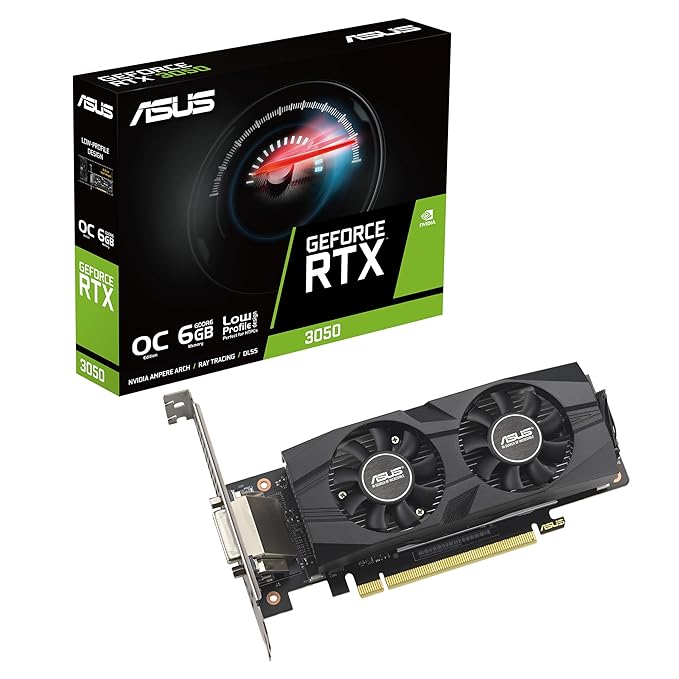
ASUS GeForce RTX 3050 LP BRK OC 6GB
Price as of May 2026Confirm live on Amazon.inOnly half-height card here
Buy this for one reason only, and it is a very specific one. The ASUS 3050 LP BRK is a low-profile, half-height card, the only one on this list that fits slim desktops, HTPC chassis and tiny SFF cases where a full-height GPU simply will not go. It comes with the low-profile bracket in the box and carries IP5X dust resistance for those tight, poorly ventilated enclosures.
Under the hood it is the same 6GB 70W RTX 3050 as the cheaper cards, with DLSS and ray tracing, so expect solid 1080p in lighter and esports titles. The catch is the price. At Rs 27,899 you pay a clear premium for the form factor, which only makes sense if your case genuinely needs low profile. In a normal tower this is poor value, so it is here purely for the SFF crowd who have no other option in this band.
What works
- Only low-profile, half-height card here
- Fits slim and SFF cases nothing else will
- 70W, no extra power needed
- IP5X dust resistance, ships with LP bracket
What is bad
- Expensive for a 6GB 3050
- Pointless premium in a normal tower
All five graphics cards compared
| Best for | Graphics card | Price | GPU chip | VRAM | Buy |
|---|---|---|---|---|---|
| Overall | ASUS Dual RX 7600 EVO 8GB | Rs 27,235 | Radeon RX 7600 | 8GB | Amazon |
| NVIDIA | GIGABYTE RTX 3050 8G | Rs 28,580 | NVIDIA RTX 3050 | 8GB | Amazon |
| Value | GIGABYTE RTX 3050 6G | Rs 20,140 | NVIDIA RTX 3050 | 6GB | Amazon |
| Compact | INNO3D RTX 3050 Twin X2 6GB | Rs 23,599 | NVIDIA RTX 3050 | 6GB | Amazon |
| Low Profile | ASUS RTX 3050 LP BRK 6GB | Rs 27,899 | NVIDIA RTX 3050 | 6GB | Amazon |
What Rs 30,000 buys you in a graphics card
At Rs 30,000 you are buying the entry rung of proper gaming graphics in India, and it is a genuinely useful rung. This is the home of the NVIDIA RTX 3050 and the AMD RX 7600, cards that play every current title at 1080p, most of them at high or ultra settings. You get hardware ray tracing, modern upscaling like DLSS or FSR, and the kind of frame rates that make esports feel sharp and AAA games look the way they are meant to. The jump from integrated graphics or an old GT-class card to anything here is night and day. What you do not get is 1440p headroom in demanding games or the VRAM to brute-force the heaviest titles at maximum textures. That is the next budget up, which I cover in the best graphics card under Rs 40,000 guide. For 1080p, which is still the resolution most Indian gamers run, this band is the sweet spot between price and real performance, and it pairs neatly with a balanced build like my PC build under Rs 1,00,000.
NVIDIA or AMD at this price
This is the real fork in the road at Rs 30,000, and the honest answer depends on what you do with the card. AMD wins on raw frames. The RX 7600 is simply faster than any RTX 3050 here in plain rasterised gaming, which is what fills your frame counter in the vast majority of titles, and it does it for a little less than the 8GB 3050. If your goal is the smoothest possible 1080p in the games you actually play, AMD is the value champ this round. NVIDIA wins on features and software. DLSS upscaling is more mature and more widely supported than AMD FSR, ray tracing runs noticeably better, and NVENC makes the 3050 a better card for streaming and recording your gameplay. NVIDIA also tends to be the safer choice for creative apps and AI tinkering. So the rule of thumb is straightforward. Want maximum frames for the rupee, go AMD with the RX 7600. Want DLSS, better ray tracing and streaming tools, go NVIDIA and buy the 8GB 3050 rather than the 6GB one. There is no wrong answer, only the one that matches how you game.
8GB or 12GB VRAM, what you need
Let me set expectations honestly, because the headline is misleading. At Rs 30,000 in India you are choosing between 6GB and 8GB cards, not 8GB and 12GB. A true 12GB card like the RTX 3060 sits above this band once you add a real AIB cooler and current stock, which is why you will not find a trustworthy one here at this money. So the real decision is 6GB versus 8GB, and in 2026 that decision matters more than it used to. A growing number of new AAA games want more than 6GB at high textures, and the 6GB 3050s, on their narrow 96-bit bus, are the cards that run short first. You will see stutter or be forced to drop texture quality. The 8GB cards, the RX 7600 and the 8GB 3050, have the breathing room to keep textures high and stay smooth. My guidance is simple. If you mainly play esports titles, older games or anything that does not chase cutting-edge graphics, 6GB is fine and saves you real money. If you want to play the newest releases at their best for the next couple of years, spend up for 8GB. It is the single most future-proofing rupee you can spend in this band.
1080p or 1440p gaming at Rs 30,000
Match the card to your monitor and you will be happy, mismatch them and you will be disappointed. Every card in this guide is built for 1080p, and at that resolution they shine. The RTX 3050s hold high to ultra settings in most games, and the RX 7600 has enough power to run 1080p ultra with frames to spare. If you own a 1080p monitor, this band is exactly right and you do not need to spend more. The 1440p question is where people overreach. A 1440p screen has 78 percent more pixels to push than 1080p, and only the RX 7600 here has any real business at that resolution, and even then at medium settings with upscaling doing some of the work, not maxed out. The 3050s will struggle at 1440p in anything demanding. So if you are gaming at 1440p and want it done properly, you should be looking at the next tier up rather than stretching a card from this one. For the 1080p majority, every pick here delivers, and a full build context lives in my Rs 1,00,000 PC build.
What to avoid at Rs 30,000
The GPU section of Amazon.in at this price is a minefield, so a few firm rules will keep you safe. First, avoid no-name brands and recycled silicon. This band is crawling with cheap RX 580, RX 550 and similar old cards from sellers you have never heard of, often dressed up with big VRAM numbers. They are slower than a modern 3050, get no real driver support and are a false economy. Stick to genuine AIB makers, ASUS, Gigabyte, MSI, Zotac, Inno3D, Sapphire and PowerColor, and to current GPUs, the RTX 3050 and RX 7600. Second, avoid pre-owned and refurbished cards listed in this range. Several do appear, and a used card with worn fans and no warranty is a gamble at this money. Third, do not overpay for a 6GB card. If you are spending close to Rs 28,000 for a 6GB 3050, you are usually better off with the faster 8GB RX 7600 or the 8GB 3050 instead, unless you specifically need low profile or compact fit. And finally, always confirm the live price and stock before you buy, because everything in this band moves fast. Do that and you will land a card that genuinely lifts your gaming rather than one that just looks like a deal.
Frequently asked questions
The verdict
At Rs 30,000 the decision comes down to frames versus features. For the most performance per rupee, buy the ASUS Dual RX 7600 EVO 8GB at Rs 27,235, my overall pick, with the speed and the 8GB of memory to keep 1080p smooth for years. If you want NVIDIA, DLSS and stronger ray tracing, take the 8GB Gigabyte RTX 3050 and skip the 6GB versions unless your budget or your case forces the issue. Spending a bit more or a bit less? See the best graphics card under Rs 40,000 for more 1440p muscle, or plan the whole rig with my PC build under Rs 1,00,000.