

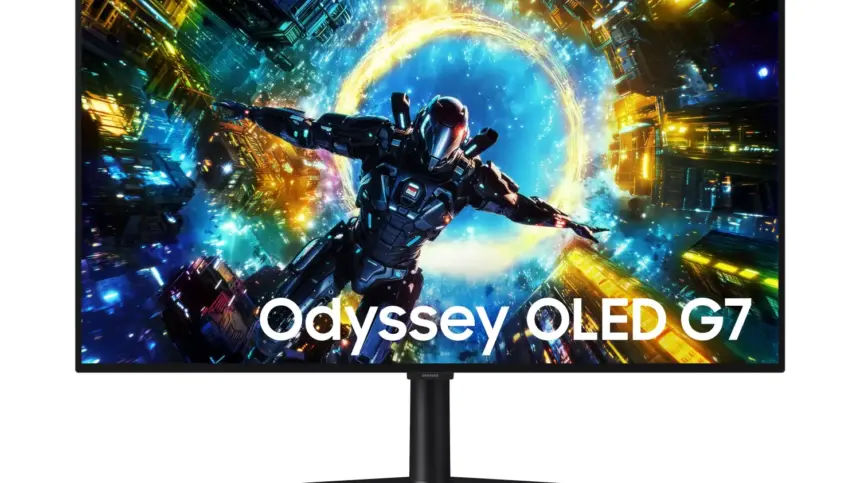
Updated May 2026 with current Indian retail prices.
Quick verdict: Samsung’s 2026 Odyssey range adds the world’s first 6K gaming monitor (the G8 G80HS) plus a fresh batch of QD-OLED and OLED panels, including a value 4K OLED G7. If you want bragging-rights resolution or top-tier OLED, this is the most interesting lineup Samsung has shipped in a while.
India reality: none of these 2026 models has an official India price or launch date yet. The only India numbers floating around are Smartprix “expected” estimates, not confirmed pricing. If your budget is real and you want something you can buy today, skip to the cheaper picks below.
Samsung announced its next-gen Odyssey gaming monitors globally on May 20, 2026, and the headline is hard to miss: the first 6K monitor built for gaming. There is a lot more going on underneath that, though, so here is the plain-English breakdown for Indian buyers, what is actually new, and what you should do if a 90 grand monitor is not in the cards.
What’s new in the 2026 Odyssey G8 and G7 lineup
One thing to get straight first: in 2026 the “Odyssey G8” name covers two completely different panel families. There are high-resolution IPS models (the 6K and 5K units) and there are QD-OLED models. They are not the same screen tech, so do not assume every G8 is an OLED. Specs below are from Samsung’s official newsroom and corroborating tech press.
The high-res IPS G8s (6K and 5K)
- Odyssey G8 G80HS (the 6K one): 32-inch IPS panel at 6,144 x 3,456 (about 224 ppi), 165Hz at native 6K, and a Dual Mode that switches to 330Hz at 3K. Peak brightness is 400 nits, with HDR10 and HDR10+ Gaming, G-Sync Compatible, FreeSync Premium, and DisplayPort 2.1. US price is $1,599.99. This is the world-first 6K gaming monitor and the viral hook of the launch. Source: Notebookcheck.
- Odyssey G8 G80HF (the 5K one): 27-inch IPS at 5,120 x 2,880 (about 219 ppi), 180Hz at native 5K, Dual Mode to 360Hz at QHD. Same 400 nits peak, HDR10 and HDR10+ Gaming, G-Sync Compatible, FreeSync Premium, DisplayPort 2.1. US price is $949.99. Source: PopSci.
Both of these are IPS, not OLED. They chase sharpness and pixel density, which matters more for design work and ultra-detailed games than for raw contrast.
The OLED line (where most gamers will actually look)
- Odyssey OLED G8 G80SH: a new 4K QD-OLED in 27-inch and 32-inch sizes, 3,840 x 2,160 at 240Hz, 0.03ms response. It uses Samsung’s 4th-gen “Penta Tandem” panel (a 5-layer stacked structure). Brightness is 300 nits in SDR and up to 1,000 nits peak, with VESA DisplayHDR True Black 500 and HDR10+ support. Connectivity is generous: DisplayPort 2.1 (UHBR20), two HDMI 2.1, and USB-C with 98W power delivery. It also gets a Glare Free coating. US pricing per PopSci is $1,299.99 for the 32-inch and $1,099.99 for the 27-inch. Sources: TFTCentral and PopSci.
- Odyssey OLED G7 G73SH (the value OLED): 32-inch 4K OLED at 165Hz with a Dual Mode up to 330Hz in FHD, 0.03ms response. Samsung is positioning this as the model that brings its OLED gaming experience to a broader price point. US price is $1,099.99. Source: PopSci.
The Penta Tandem story (the other real upgrade)
Beyond the 6K stunt, the new QD-OLED panel is the upgrade that affects daily use. Samsung’s 4th-gen “Penta Tandem” structure stacks five layers instead of the older four. That brings roughly 1.3x higher luminous efficiency, close to double the panel lifespan, and a peak brightness ceiling rated up to 1,300 nits on the panel platform, against the prior roughly 1,000 nit limit. For anyone who has worried about OLED burn-in or wished OLED monitors hit harder in bright HDR, that is the meaningful bit. Source: Tom’s Hardware.
Samsung Odyssey 2026 spec comparison (all four new models)
Here are the four 2026 models side by side, so you can see exactly how the 6K, 5K, and the two OLEDs differ. Every figure here comes from the sources cited in the sections above. Where Samsung has not published a per-model number, we have left it as “Not specified” rather than guess.
| Spec | G8 6K (G80HS) | G8 5K (G80HF) | OLED G8 (G80SH) | OLED G7 (G73SH) |
|---|---|---|---|---|
| Size | 32-inch | 27-inch | 27-inch and 32-inch | 32-inch |
| Panel | IPS | IPS | QD-OLED (Penta Tandem) | OLED |
| Resolution | 6K, 6,144 x 3,456 (about 224 ppi) | 5K, 5,120 x 2,880 (about 219 ppi) | 4K, 3,840 x 2,160 | 4K, 3,840 x 2,160 |
| Refresh (Dual Mode) | 165Hz native (330Hz at 3K) | 180Hz native (360Hz at QHD) | 240Hz (no Dual Mode) | 165Hz native (330Hz at FHD) |
| Brightness | 400 nits peak, no local dimming | 400 nits peak | 300 nits SDR, up to 1,000 nits peak, DisplayHDR True Black 500 | Not specified |
| Ports | DisplayPort 2.1, HDMI 2.1 | DisplayPort 2.1 | DisplayPort 2.1 (UHBR20), 2x HDMI 2.1, USB-C 98W | Not specified |
| US price | $1,599.99 | $949.99 | $1,299.99 (32-inch), $1,099.99 (27-inch) | $1,099.99 |
Note: “Not specified” means Samsung has not published that figure per model at the time of writing, not that the monitor lacks the feature. We will fill these in once official India spec sheets go live.
India price, availability, and the warranty question
Here is the honest part. As of now there is no official India launch and no official India price for any of the 2026 models (G80HS, G80HF, G80SH, G73SH). Samsung has only confirmed global availability. The global announcement landed on May 20, 2026, with US pre-order rewards running through June 9, per Sammy Fans.
The only India figures anyone is quoting right now are Smartprix “expected price” estimates, which are not Samsung pricing and can be off by a wide margin once a real launch happens. Treat these as guesses, not gospel:
- Odyssey G8 6K (G80HS): around Rs 89,999 (expected, not official)
- Odyssey G8 5K (G80HF): around Rs 74,999 (expected, not official)
- Odyssey OLED G8 32-inch (G80SH): around Rs 79,999 (expected, not official)
One reason to be suspicious of that Rs 89,999 figure for the 6K: it is the most expensive model in the range at $1,599.99 in the US, well above the OLED G8 and OLED G7. A genuine India MRP that lands the flagship 6K below the OLED models would be unusual. We are deliberately not converting the US dollar prices into rupees, because that math never matches actual India MRP once GST, import structure, and Samsung’s local positioning come in. When Samsung India confirms real numbers, we will update this post.
Sale timing: if these do land officially in India, the realistic windows to watch for any discount are the big festive sales, Flipkart Big Billion Days and the Amazon Great Indian Festival around October. High-end monitors rarely drop much at launch, so patience usually pays here.
Warranty and grey-import caution: with no India launch, there is no official Samsung India warranty or service coverage for these models yet. If you spot one on a grey-import or reseller listing before an official launch, understand that you would likely have no local warranty and no easy service path. That is a genuine risk on a monitor in this price range, so we would not recommend chasing an imported unit just to be early.
For context, last year’s 27-inch 4K 240Hz QD-OLED, the 2025 Odyssey OLED G8 G81SF, is listed on Samsung India at Rs 81,299 but currently shows as Out of Stock and not for sale. So even the previous-gen OLED is not something you can simply add to cart today. That makes the “what can I actually buy now” question below the important one.
What PC do you actually need to drive 6K (or 4K OLED) gaming?
Short answer: a lot more than most Indian gaming rigs have, and that matters more than the monitor price. Resolution scales the number of pixels your GPU has to draw every frame, and 6K is brutal here.
Run the math. 4K (3,840 x 2,160) is about 8.3 million pixels per frame. The G80HS at 6,144 x 3,456 is about 21.2 million pixels, roughly 2.5x the pixel load of 4K and close to 5x that of 1440p. Now layer on the refresh target: 165Hz means your GPU needs to push those 21 million pixels up to 165 times a second. That is an enormous ask even before ray tracing enters the picture.
There is a second wall: link bandwidth. Native 6K at 165Hz needs serious output bandwidth, which is exactly why these monitors ship with DisplayPort 2.1 rather than older DisplayPort 1.4. Your graphics card has to support that newer standard to drive native 6K at full refresh, so an older card with only DisplayPort 1.4 will not feed this panel properly no matter how fast its core is.
Practically, for native 6K high-refresh gaming you are looking at a current top-tier card, and even then you will lean on upscaling like DLSS or FSR to hit triple-digit frame rates in demanding titles. The 4K OLED models are far more realistic to drive: a strong upper-mid to high-end GPU can run 4K with upscaling comfortably, and the Dual Mode trick (dropping to FHD at a higher refresh) gives competitive players an easier-to-drive option for esports.
The India angle that nobody mentions: the GPU that can properly feed a native 6K 165Hz panel costs more in India than the monitor itself, often a lot more, once import duty and GST stack up. So before you even think about the 6K, price the graphics card first. For most Indian gamers, a 4K OLED paired with a sensible high-end GPU, or a QHD high-refresh setup, delivers a better real-world experience for the money than a 6K screen your PC cannot fully use.
IPS 6K vs QD-OLED: which should you actually buy?
This is the decision that actually matters, because the 6K headline hides a tradeoff. The 6K G80HS and the 5K G80HF are IPS panels: 400 nits peak, no local dimming mentioned in the spec sheet. IPS is excellent for sharpness and pixel density, but it cannot match OLED for contrast and inky blacks, so HDR will not “pop” the way it does on the OLED models. What the 6K gives you is sheer detail and screen real estate, which is genuinely useful if you mix heavy creative or productivity work with gaming. Think of the 6K as a two-in-one sharpness-and-desktop monitor that also games, not an HDR or esports king.
The QD-OLED G80SH, by contrast, is the better pure gaming panel. It runs 4K at 240Hz with 0.03ms response, hits up to 1,000 nits peak with DisplayHDR True Black 500, and uses the new Penta Tandem structure that improves brightness efficiency and panel longevity. For fast games, HDR atmosphere, and per-pixel contrast, OLED wins comfortably. The OLED G7 (G73SH) is the value route into the same OLED look, at 165Hz with a Dual Mode up to 330Hz in FHD.
So the honest guidance: if your priority is gaming feel, HDR impact, and motion, get an OLED (the G80SH if you want the 240Hz flagship, the G7 G73SH if you want OLED for less). If your priority is maximum sharpness, pixel density, and a big productive desktop that also games decently, the 6K IPS is the unusual pick that makes sense. For the majority of Indian gamers, the OLED route is the smarter buy, and it is also the closer match to what you can already get in this segment today.
Should you buy, or get a cheaper monitor that fits your budget?
Real talk: the 6K G80HS is a halo product. It is exciting, it is a world-first, and for the vast majority of Indian gamers it is the wrong buy. You need a serious GPU to even feed 6K, and there is no India price yet anyway. The OLED G7 and OLED G8 are more sensible, but they still sit in the roughly Rs 75,000 to Rs 90,000 expected band with no confirmed local availability or warranty.
If you want a great gaming monitor you can buy on Amazon.in or Flipkart this week, with India pricing and warranty sorted, you have strong options at every budget. Here is where to go:
- Closest step-down from this Odyssey tier: our premium 4K gaming monitors under Rs 50,000 guide. This is the most natural bridge if the Odyssey feels like a stretch but you still want premium picks.
- Solid mid-budget sweet spot: best gaming monitors under Rs 30,000, where high-refresh QHD panels genuinely shine for the money.
- Same QHD high-refresh class, cheaper: QHD 165Hz monitors under Rs 25,000, arguably the best value tier for most gamers.
- Budget floor that still games well: value 1440p gaming monitors under Rs 20,000.
- Want the full picture across every budget: our full best gaming monitors in India guide.
Bottom line: bookmark this Odyssey page for when Samsung confirms India pricing, but if you are buying now, one of the guides above will get you far more gaming for your rupee.
Watch: the 2026 Odyssey lineup in action
Worth a look before you decide. Samsung’s own feature film shows off the 6K G8, and two independent CES 2026 hands-on videos walk through the wider lineup so you can judge the panels for yourself.

Video: Samsung via YouTube (Samsung’s own feature film, not an independent review)

Video: Viktor’s Reality via YouTube

Video: FrogboyX1Gaming & Tech Reviews via YouTube
FAQ
What is the Samsung Odyssey G8 6K price in India?
There is no official India price yet. Samsung has not announced an India launch for the 2026 Odyssey G8 6K (G80HS). The only India figure available is a Smartprix expected estimate of around Rs 89,999, which is not confirmed pricing. Its US price is $1,599.99.
Are the 2026 Samsung Odyssey monitors available in India?
Not yet. As of now the 2026 lineup (G80HS, G80HF, G80SH, G73SH) is confirmed for global and US availability only. There is no India launch date or official India pricing. We will update this post when Samsung India confirms.
Is the Samsung 6K Odyssey monitor OLED?
No. The 6K G80HS is an IPS panel, not OLED. So is the 5K G80HF. Only the Odyssey OLED G8 (G80SH) and Odyssey OLED G7 (G73SH) in the 2026 range use OLED tech. If you want OLED contrast and HDR pop, the 6K is not the model to chase.
What GPU do you need for 6K gaming?
A current top-tier graphics card, and even then you will rely on upscaling like DLSS or FSR to hit high frame rates. The G80HS pushes about 21 million pixels per frame, roughly 2.5x the load of 4K, and needs DisplayPort 2.1 output, which older cards do not have. In India, that level of GPU usually costs more than the monitor itself, so price the card before the screen.
Is the 6K Odyssey G8 worth it for gaming?
For most people, no. It is a 165Hz IPS panel, not OLED, and pushing 6K needs a very powerful GPU. It is impressive as a world-first and great for sharpness plus a big productive desktop, but a 4K OLED or a high-refresh QHD monitor is the smarter buy for actual gaming. If your budget is tighter, the cheaper India options linked above make far more sense.
Should I buy the 6K IPS G8 or the 4K OLED G8?
For gaming feel, HDR impact, and fast motion, the OLED G8 (G80SH) wins: 4K at 240Hz, up to 1,000 nits peak, DisplayHDR True Black 500. The 6K IPS makes sense only if you want maximum sharpness and a large productive desktop that also games. Most gamers should pick the OLED.
What is the difference between the Odyssey OLED G8 and OLED G7 (2026)?
Both are 4K. The OLED G8 (G80SH) is a 240Hz QD-OLED with the new Penta Tandem panel, up to 1,000 nits peak, USB-C with 98W power, and a Glare Free coating, in 27-inch and 32-inch. The OLED G7 (G73SH) is a 32-inch 165Hz OLED (Dual Mode up to 330Hz in FHD) positioned as the more affordable OLED option.
What is the Penta Tandem panel in the 2026 Odyssey OLED?
It is Samsung’s 4th-gen QD-OLED structure that stacks five layers instead of four. It brings roughly 1.3x higher luminous efficiency, close to double the panel lifespan, and a higher peak brightness ceiling on the panel platform. In short, brighter HDR and better burn-in resilience than older OLED monitors.
Gaming monitors you can buy in India right now
The 2026 Odyssey has no India launch yet. If you want a great screen today, these are available on Amazon India:
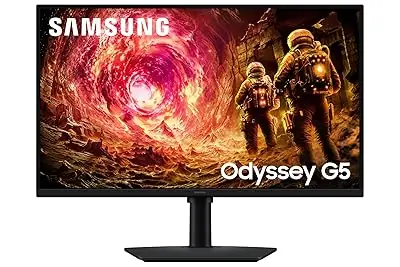
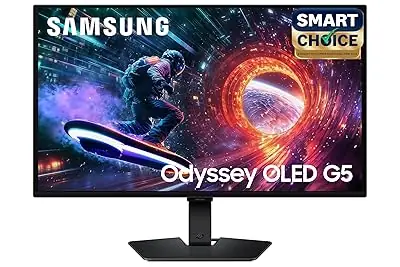
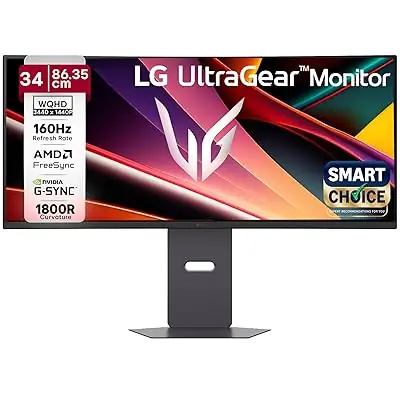
Prices update often, tap through for the live Amazon price. As an Amazon Associate we earn from qualifying purchases.