
Updated June 2026 with current Indian retail prices.
At Rs 50,000 you reach the flagship tier, where the question stops being how good a panel can get and starts being which kind of greatness you want. This budget buys OLED contrast, 4K sharpness, or 240Hz speed, but not all at once, so the choice is about your priorities and the GPU you own. I checked the live specs and prices on every pick, so these are the four genuinely worth buying under Rs 50,000 in 2026, and how to choose between them.
My pick is the Samsung Odyssey QD-OLED G5 at Rs 47,299 for the best image quality at this budget. For 4K value, the LG 27GR93U at Rs 44,999 is the safe all rounder. Every figure here was pulled live from Amazon.in this month, but flagship stock and pricing swing fast, so always open the listing and check before you commit.
Before you spend this much
- Rs 50,000 unlocks the real flagship panels, OLED contrast, 4K detail, or 240Hz speed. You pick one strength, not all three.
- Every panel here needs a serious GPU. An RTX 4070 Ti or better is the realistic floor to use 4K or 240Hz properly.
- OLED gives the best image but carries a small burn in risk. IPS is the safe choice for mixed work and play.
What Rs 50,000 unlocks, OLED, 4K, or 240Hz
This is the tier where you stop compromising and start specialising. Each panel here is a flagship at one thing. The QD-OLED Samsung is the image quality king, with contrast and colour nothing else matches. The 4K panels from LG and Samsung give you the sharpest, most detailed picture and the most desktop space. The MSI chases pure speed with 240Hz for competitive players. What you cannot do, even at Rs 50,000, is get OLED, 4K and 240Hz in one screen, those combinations exist but start well above this budget. So decide what matters most to you, contrast, sharpness or speed, and buy the panel that nails it. The sections below break down each choice.
The 4 best gaming monitors under Rs 50,000
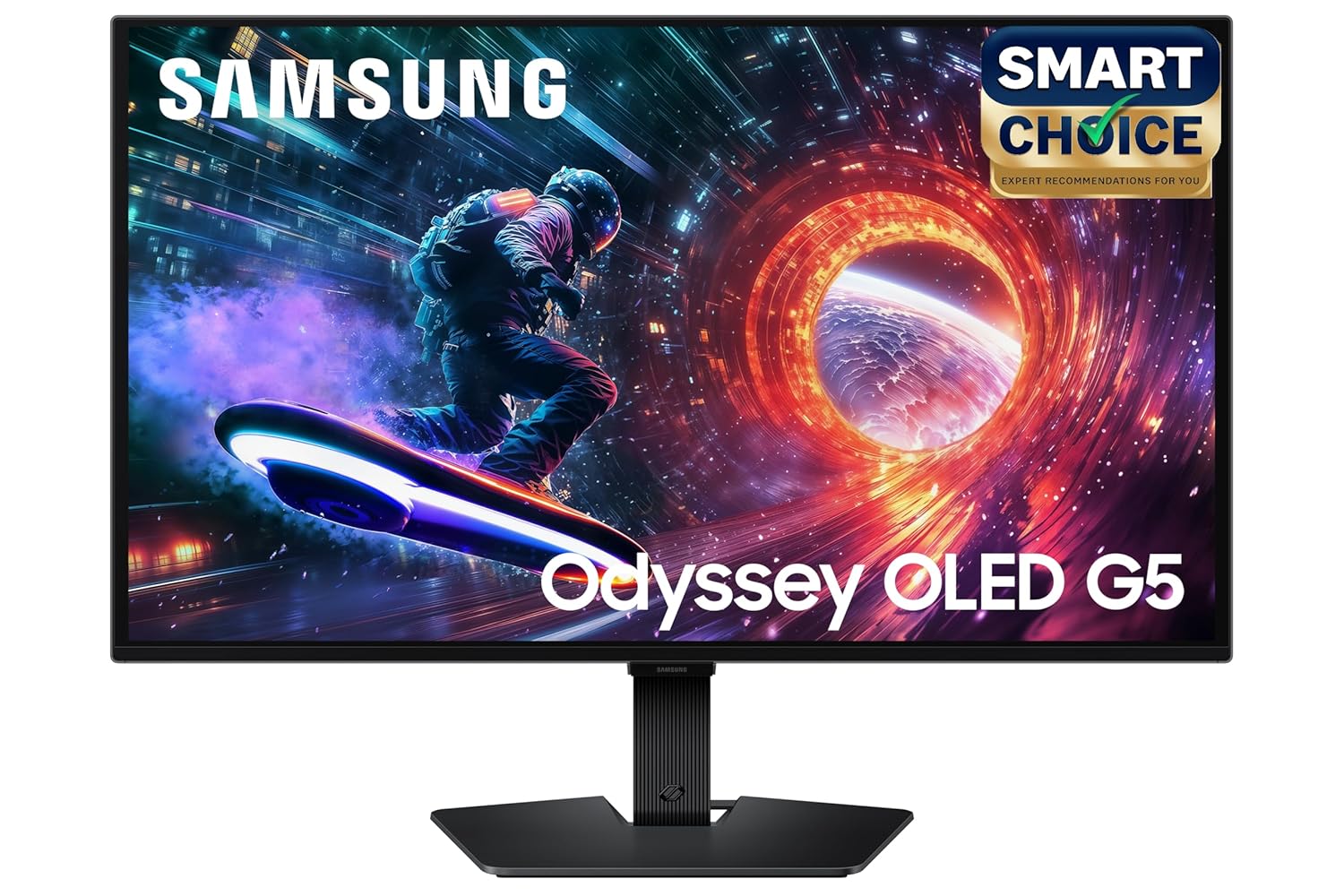
Samsung Odyssey QD-OLED G5
Price as of May 2026Confirm live on Amazon.inQD-OLED panel
The Samsung Odyssey QD-OLED G5 is the image quality champion of this list. QD-OLED means each pixel makes its own light, so blacks are perfect, contrast is effectively infinite, and the colour volume is richer than any IPS or VA panel here. Pair that with a near instant pixel response and 180Hz, and games look and feel spectacular, especially dark, atmospheric titles.
OLED comes with one caveat, the small long term risk of burn in from static elements left on screen for many hours, so it suits gaming and media more than a static work desktop all day. Samsung includes burn in protection features to manage this. If picture quality is your priority and you mostly game, nothing else here comes close at Rs 47,299.
What works
- QD-OLED, perfect blacks and infinite contrast
- Near instant pixel response, no smearing
- Richest colour of any panel here
- 180Hz and HDR10 with USB-C
What is bad
- Small long term burn in risk from static elements
- QHD not 4K, so less pixel dense than the 4K picks
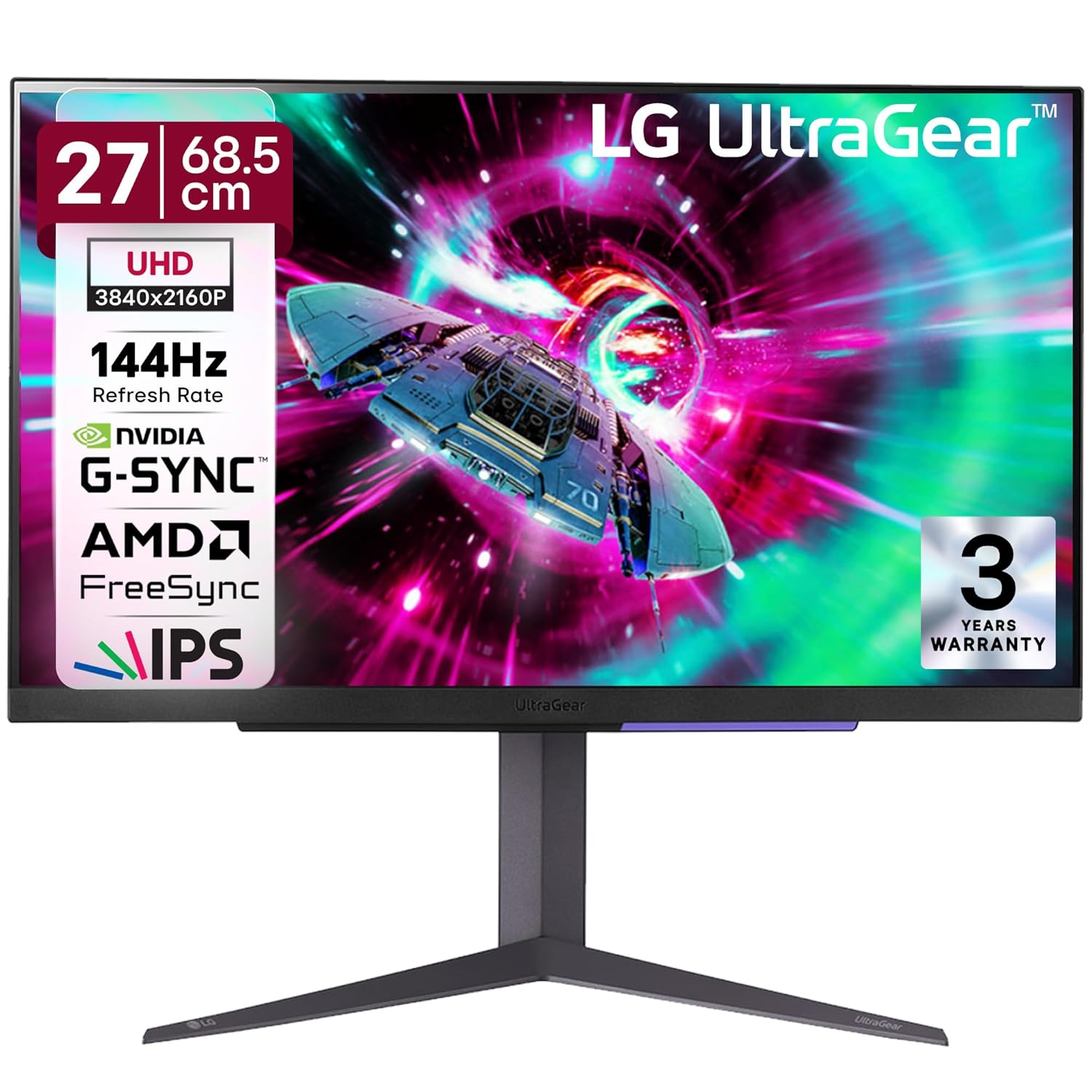
LG 27GR93U UltraGear
Price as of May 2026Confirm live on Amazon.in4K 144Hz IPS
The LG 27GR93U UltraGear is the no compromise 4K pick. It is a 27 inch 4K IPS running 144Hz, so you get genuine pixel sharpness for both games and work plus a high enough refresh for smooth, responsive play. IPS means no burn in worry and reliable colour, and LG UltraGear tuning keeps motion clean.
It is the cheapest pick here at Rs 44,999 and the most versatile, equally at home for sharp productivity, content and high refresh gaming. It does not have the OLED contrast or the 240Hz of the specialist panels, but as a do everything 4K monitor at the high end, it is the safe, excellent choice.
What works
- 4K and 144Hz, sharp and smooth
- IPS, no burn in risk and reliable colour
- Cheapest pick here at Rs 44,999
- Great all rounder for work and play
What is bad
- IPS blacks cannot match OLED
- 144Hz, behind the 240Hz esports pick
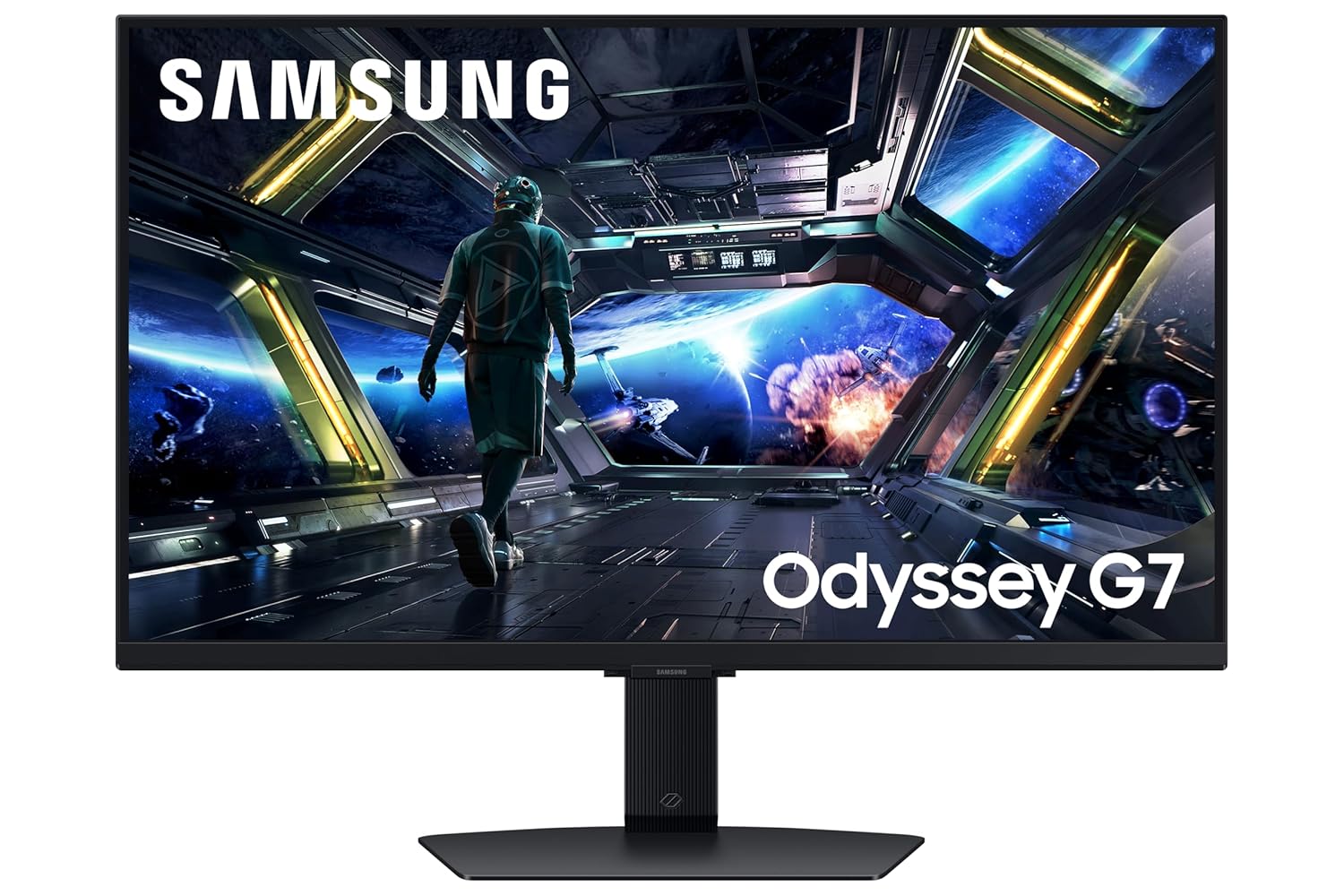
Samsung Odyssey G7 4K
Price as of May 2026Confirm live on Amazon.in4K Fast IPS, smart
The Samsung Odyssey G7 is the feature loaded 4K gaming pick. The 27 inch 4K Fast IPS panel runs at 144Hz with HDR400, and Samsung adds its smart platform, so you can stream apps without a PC attached, a genuine bonus if the monitor doubles as a media screen. Colour and uniformity are strong, as you expect from Samsung.
Against the LG it is a touch pricier for a very similar core spec, with the smart features and Samsung tuning as the difference. At Rs 46,699 it is the pick if you want a 4K gaming panel that also works as a standalone smart display, rather than the leanest 4K buy.
What works
- 4K Fast IPS at 144Hz
- Built in smart apps, works without a PC
- Strong Samsung colour and uniformity
- HDR400 and USB-C
What is bad
- Pricier than the LG for a similar core spec
- 144Hz, not the fastest here
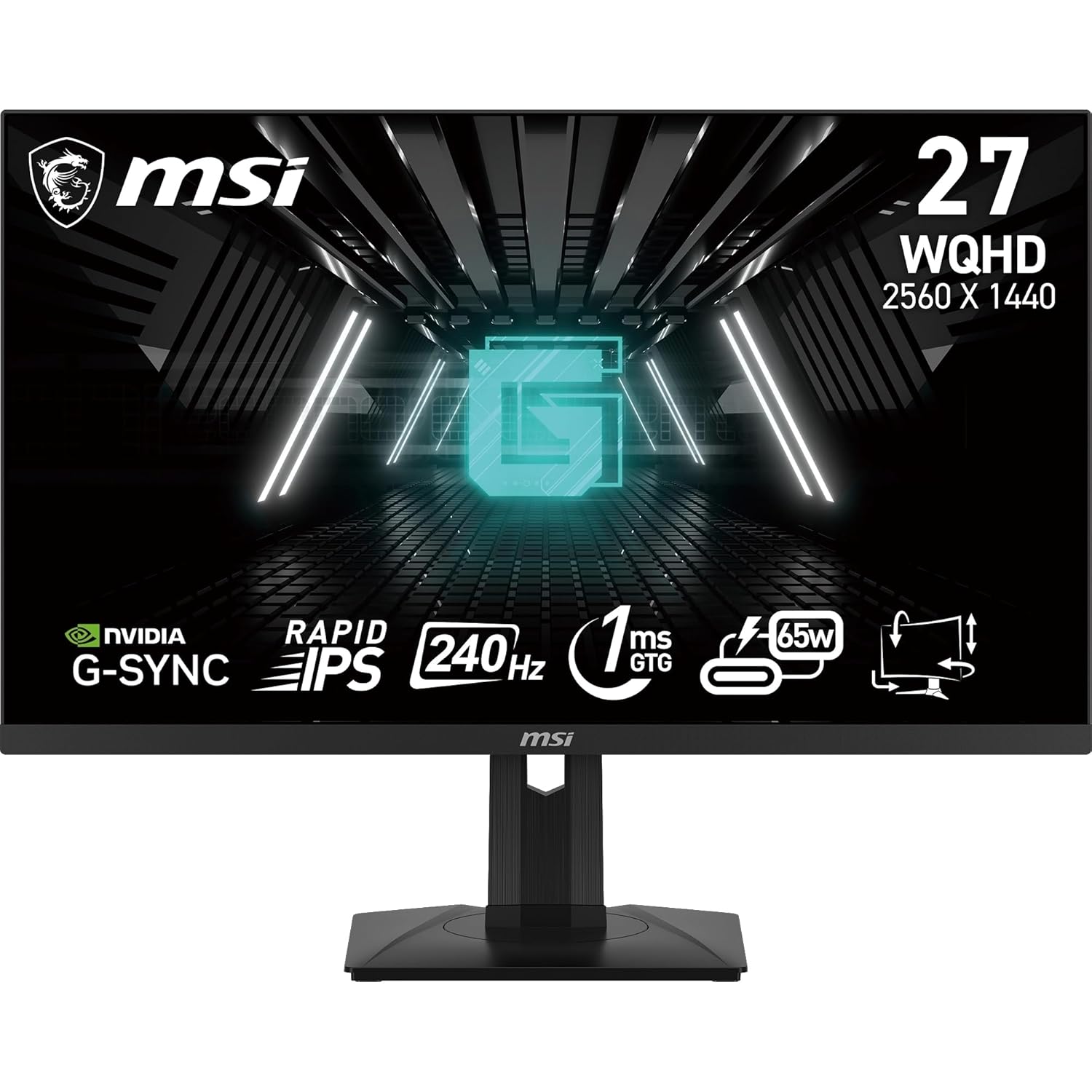
MSI G274QPX
Price as of May 2026Confirm live on Amazon.inQHD 240Hz
The MSI G274QPX is the pure speed pick. It runs QHD at 240Hz on a Rapid IPS panel, the highest refresh on this list, and for competitive shooters that extra fluidity and lower input lag are a real edge. QHD keeps the load manageable so a strong GPU can actually hit those frame rates, and HDR400 plus USB-C round it out.
It is the specialist here, choosing 240Hz speed over 4K sharpness or OLED contrast. If you are a serious competitive player chasing every frame, this is the one. If you play slower or single player games, the 4K and OLED picks give you a better looking image for the same money.
What works
- 240Hz, the fastest panel here
- Rapid IPS, crisp motion and low lag
- QHD is achievable at high frames
- HDR400 and USB-C
What is bad
- QHD, not 4K sharp
- 240Hz needs a powerful GPU to use fully
All four compared
| Best for | Monitor | Price | Panel | Refresh | Buy |
|---|---|---|---|---|---|
| Overall | Samsung Odyssey QD-OLED G5 | Rs 47,299 | QD-OLED | 180Hz | Amazon |
| 4K value | LG 27GR93U UltraGear | Rs 44,999 | IPS 4K | 144Hz | Amazon |
| 4K gaming | Samsung Odyssey G7 4K | Rs 46,699 | Fast IPS 4K | 144Hz | Amazon |
| For FPS | MSI G274QPX | Rs 45,115 | Rapid IPS | 240Hz | Amazon |
Notice how tightly the prices sit, barely a few thousand rupees apart, yet each panel chases a completely different ideal. One bets everything on contrast, two on resolution, one on raw frame rate. That means your decision here is not about saving money, it is about which kind of excellence you value and whether your graphics card can keep up.
QD-OLED or IPS at the high end, is OLED worth it
This is the defining choice at Rs 50,000. QD-OLED, on the Samsung G5 here, gives you perfect per pixel blacks, effectively infinite contrast, instant response and the richest colour available, and the difference in a dark game or film is genuinely jaw dropping. IPS, on the LG and the other Samsung, cannot match that contrast, its blacks look grey by comparison, but it is brighter for daytime use, has no burn in risk, and is the safe choice if your monitor pulls double duty as an all day work screen. The honest summary, OLED for the best image and mostly gaming use, IPS for peace of mind and mixed work and play. If picture quality is your top priority and you game more than you grind spreadsheets, the OLED is worth every rupee.
4K 144Hz or QHD 240Hz, which flagship path
If you go the IPS route, the next fork is resolution versus refresh. The 4K panels give you four times the pixels of 1080p, so the image is incredibly sharp and you get loads of workspace, ideal for slower games, single player epics and creative work, at 144Hz which is plenty smooth. The QHD 240Hz MSI flips the priority, less sharp but blisteringly fast, which is exactly what competitive shooter players want for the lowest input lag and clearest motion. Ask yourself what you play most. If it is story driven or visually rich games, 4K wins. If it is competitive multiplayer, 240Hz wins. Both are excellent, they just serve different players.
The GPU reality for 4K and 240Hz
Flagship monitors need flagship graphics cards, and this is where the spend has to be balanced. To drive 4K at high frame rates you want an RTX 4080 class card, with an RTX 4070 Ti as the realistic floor for slightly lower settings. To actually feed a 240Hz panel in modern games you also need a powerful card, since hitting 240 frames is demanding even at QHD. Pairing a Rs 50,000 monitor with a mid range GPU wastes most of what you paid for, you will run 4K at low frame rates or never get near 240Hz. Budget the GPU first at this tier, then the monitor, or the screen will outrun your hardware.
Burn-in, HDR and what you are really paying for
Two things to understand before you spend this much. Burn in applies only to the OLED, and it is a manageable long term risk, not an immediate problem, modern QD-OLED panels include pixel shift and refresh features to mitigate it, and for a screen used mainly for varied gaming and media it is rarely an issue, but it is the reason to pick IPS if you display static work elements all day. HDR finally starts to mean something at this tier, the OLED delivers genuine HDR thanks to its per pixel contrast, while the IPS panels at HDR400 still only manage a mild effect. So at Rs 50,000 you are paying for a real panel upgrade, OLED contrast, 4K resolution or 240Hz speed, all of which are genuine, unlike the HDR badge at lower prices. Pick the strength you value and you are getting real flagship hardware.
Best Gaming Monitors by Budget
Jump to the right price band for your setup. Every list is India-priced and updated for 2026.
See all best gaming monitors in IndiaFrequently asked questions
The verdict
At Rs 50,000 you are buying a genuine flagship, so pick the strength that matters most to you. The Samsung Odyssey QD-OLED G5 at Rs 47,299 is my top pick for the best image quality on the list, perfect blacks and stunning colour for gaming and media. The LG 27GR93U at Rs 44,999 is the safe 4K all rounder with no burn in worry, the Samsung Odyssey G7 adds smart features to 4K gaming, and the MSI G274QPX is the 240Hz pick for competitive players. Decide between contrast, sharpness and speed, pair it with a strong GPU, and you have a setup that will last years.
Building the full rig? Step down to the best gaming monitor under Rs 40,000 or the best under Rs 20,000, up to the best under Rs 60,000, or pair your screen with the Rs 1,00,000 PC build.