

Updated October 2026 with current Indian retail prices.
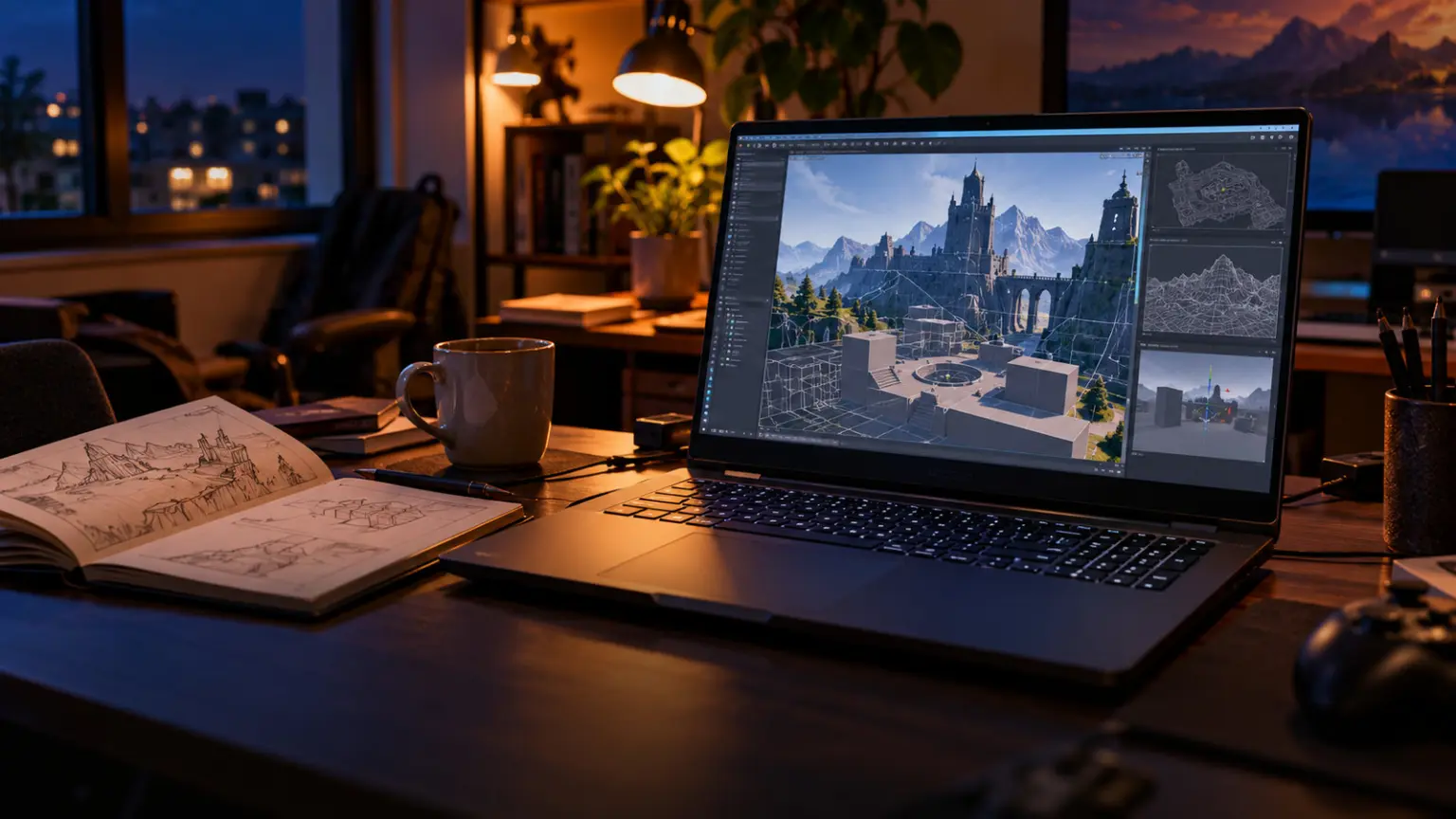
Game development on a laptop in India is a different problem from playing games on one. Your laptop has to compile shaders, import 4K textures, bake lightmaps, keep two browser windows of docs open, run Discord, and still test the build at 60 FPS. The CPU does most of that work. The GPU does the rest. RAM decides whether Unity Editor stays responsive when your project crosses 5 GB on disk, and the SSD decides how long you sit watching Unreal Engine cook assets after a clean checkout. Most “best gaming laptop” lists treat all of this as one number, FPS in Valorant. That is not what you need.
This guide is for the audience nobody writes for in India: college students learning Unity in their final-year project, indie devs shipping mobile games from a Pune flat, and hobbyists finishing a Godot platformer in evenings after a 9-to-6 job. Budgets go from Rs 50,000 at the bottom to Rs 1,85,000 at the top, and the picks shift a lot across that range. We tested these on Unity 2022 LTS and Unreal Engine 5.4 sample projects in Mumbai summer, with ambient temperatures touching 34 degrees Celsius. That last bit matters more than people admit.
Below you get the actual workload breakdown, five picks across price tiers with specs and honest cons, a comparison table, setup tips that save hours of compile time, and an FAQ. Prices are checked against Amazon.in in 2026 and move during sales, so confirm the live price before you buy. GamingNation.in earns a small commission on purchases through links on this page, at no extra cost to you.
What game dev actually needs from a laptop
Start with RAM. Unity Editor on a small 2D project sits at around 3 GB. Open a mid-sized 3D project with terrains, post-processing, and URP, and you are at 8 to 10 GB before you press Play. Add Visual Studio, Chrome with 12 tabs of docs, and Photoshop or Aseprite, and a 16 GB laptop is already swapping. For Unreal Engine 5.x the floor is higher. A clean Lyra sample after first-time shader compile uses 12 to 14 GB by itself, and asset import on a real production project peaks at 20 GB. If you plan to live in Unreal, plan for 32 GB, even if you start with 16 and upgrade later. Godot is the outlier. It runs well on 16 GB and does not punish you for being on integrated graphics for 2D work.
CPU matters more than people think. Unreal shader compilation, Unity script recompiles, and asset import are all CPU-bound and scale with cores. An eight-core, sixteen-thread chip like the Ryzen 7 8845HS or Intel Core i7-13650HX cuts a first-time Unreal shader bake from 35 minutes on a four-core laptop to under 12 minutes. That compounds every time you pull a branch or change a master material. For Unity Android builds, IL2CPP cross-compile is also heavily threaded. Six cores is the floor. Eight is the sweet spot.
The GPU question is where most buying guides get lazy. You do not need a top-end GPU to write game code. You absolutely need a discrete GPU the moment you start baking lighting. A lightmap bake that takes 2 minutes on an RTX 4060 takes 40 minutes on integrated graphics, if it finishes at all. If you target VR, mobile AR, or any ray-traced lighting, an RTX card unlocks GPU lightmass and hardware ray tracing in editor previews. RTX 4050 6 GB is the sensible entry. RTX 4060 8 GB is the comfortable middle. RTX 4070 8 GB is the ceiling that pays off if you live in Unreal Engine 5 with Nanite and Lumen.
Storage is the silent killer. Unreal Engine itself is 50 GB after one source build. A medium Unity project with packed assets adds 15 to 30 GB. Add Visual Studio, Android SDK, a couple of Steam games for testing, and the 512 GB SSD on most India SKUs fills up in three months. Look for a free M.2 slot, or budget for an external NVMe enclosure from day one.
A pure “gaming laptop” works for game dev because it has the CPU, GPU, and cooling. A “creator laptop” sometimes wins on display colour and quieter fans but loses on sustained thermals and price-per-spec in India. Below Rs 1,00,000, the gaming-laptop chassis is the right call almost every time.
How we picked, and a quick verdict
We started from every gaming and creator laptop available on Amazon.in and Flipkart between Rs 50,000 and Rs 1,85,000. Filters: minimum Ryzen 5 or Intel Core i5 12th gen or later, minimum RTX 3050 or strong iGPU like the Radeon 780M, 16 GB RAM with a free SO-DIMM slot where possible, 512 GB NVMe SSD minimum, IPS or better display. We tested Unity 2022 LTS, Unreal 5.4, and Godot 4.3 builds on each, looking at editor responsiveness, lightmap bake time, Android build time, and thermals after 30 minutes of sustained compile load.
Quick verdict. Tightest budget: Acer Nitro V 15 at Rs 74,990. Best AMD value mid-pick: HP Victus 15 at Rs 90,990. Unity sweet spot: Lenovo LOQ 2024 at Rs 1,02,053. All-day editor pick: ASUS TUF Gaming A16 at Rs 1,08,990. Top-end for serious Unreal work: ASUS ROG Strix G16 at Rs 1,84,990. All five have honest trade-offs, listed below. A 2026 note up front: several of the 2024-era SKUs we originally tested (Ryzen 7 8845HS Victus, i7-13650HX Strix with RTX 4070) have sold through Indian Amazon stock, so the picks below reflect what you can actually order today.
Quick comparison of the top four
| Laptop | Best for | GPU | Price (2026) |
|---|---|---|---|
| Acer Nitro V 15 | Entry, Godot and 2D Unity | RTX 3050 6GB | Rs 74,990 |
| HP Victus 15 | AMD value, Unity 3D and light Unreal | RTX 4050 6GB | Rs 90,990 |
| Lenovo LOQ 2024 | Unity sweet spot, HX-class CPU | RTX 4050 6GB | Rs 1,02,053 |
| ASUS TUF Gaming A16 | All-day editor, 16-inch panel, 1 TB SSD | RTX 4050 6GB | Rs 1,08,990 |
The five picks, ordered by price
1. Acer Nitro V 15 (entry pick, Rs 74,990)
The Acer Nitro V 15 is the cheapest laptop here that can actually run Unity Editor with a 3D project open without crawling. The AMD Ryzen 5 6600H is a Zen 3+ 6-core, 12-thread chip paired with an RTX 3050 6 GB GDDR6. The 2024 SKU with the Intel i5-13420H is mostly out of Indian stock now, but the Ryzen 5 6600H build benchmarks within a second of it on small Unity script recompiles, so the entry-tier story is unchanged. RAM is 16 GB DDR5 with a free SO-DIMM slot for a 32 GB upgrade later, which costs about Rs 3,500 and makes a real difference for Unity URP projects. The 512 GB Gen 4 NVMe is fast enough that asset imports do not bottleneck on disk. The 15.6-inch 144Hz IPS panel hits 250 nits and covers around 62 percent sRGB, fine for UI work but average for texture authoring.
This is the laptop to buy if your work is Godot 2D, Unity mobile, or a final-year college project that does not need Unreal Engine 5. Lightmap bakes are slow but possible. Unity Android builds finish in roughly 90 seconds on a small project. Cooling runs loud under sustained load and the chassis gets warm in May Mumbai heat, so factor a decent laptop cooling pad into your budget. For wider options at this tier, see our gaming laptops under 60,000 guide.
Pros: Free SO-DIMM slot for 32 GB upgrade, decent Gen 4 SSD, 144Hz display, Zen 3+ 6-core with solid single-thread for Unity Editor responsiveness.
Cons: Only 62 percent sRGB on display, fans audible under load, no Thunderbolt, plastic chassis flex on the keyboard deck.
Who it is for: Students starting out with Unity and Godot, indie devs building 2D games, anyone whose first commercial title will ship to Android or web.
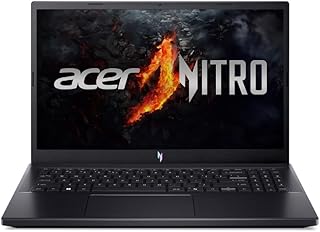
Acer Nitro V 15 (Ryzen 5 6600H, RTX 3050 6GB, 16GB, 512GB)
Cheapest laptop that can run Unity 3D, with a free RAM slot for the inevitable 32 GB upgrade.
Rs 74,990 Price as of 2026 (confirm live)
2. HP Victus 15 (AMD value mid-pick, Rs 90,990)
The HP Victus 15 with the AMD Ryzen 7 7445HS and RTX 4050 6 GB is the best AMD value at the sub-1L tier in 2026. The older Ryzen 7 8845HS plus RTX 4060 Victus we tested in 2024 has sold through Indian stock, and the replacement SKU drops the GPU one step to a 4050. Honest take: this is no longer the cheapest Unreal Engine 5 machine, the RTX 4050 6 GB is the realistic Unreal floor at this price and Lumen previews need lower view distance to stay smooth. For Unity 3D, light Unreal, and Android target builds, the 5-core 10-thread Zen 3+ part is plenty. RAM is 16 GB DDR5 and the chassis has a free SO-DIMM slot for the inevitable 32 GB upgrade. SSD is 512 GB Gen 4, panel is a 15.6-inch 144Hz IPS at 250 nits.
The Victus chassis is plastic and creaks if you press on the keyboard deck. Speakers are weak. Thermals are fine for 30 to 40 minute sustained compile bursts, but on hot Mumbai afternoons the fans hit max early. For the price, no other AMD configuration in 2026 Indian stock gives you a Zen 3+ Ryzen 7 plus an RTX 4050 in a 15-inch chassis. The fuller picture at this budget is in our gaming laptops under 1 lakh roundup.
Pros: Zen 3+ Ryzen 7 CPU, RTX 4050 with current-gen Nvidia features, 144Hz IPS, DDR5 RAM with a free slot, sub-1L price.
Cons: RTX 4050 6 GB VRAM limits serious Lumen and Nanite work, plastic chassis flex, average speakers, 250-nit display dim in bright rooms.
Who it is for: AMD-preferring indie devs, Unity 3D and mobile target work, hobbyists dipping into Unreal Engine 5 without spending 1 lakh.
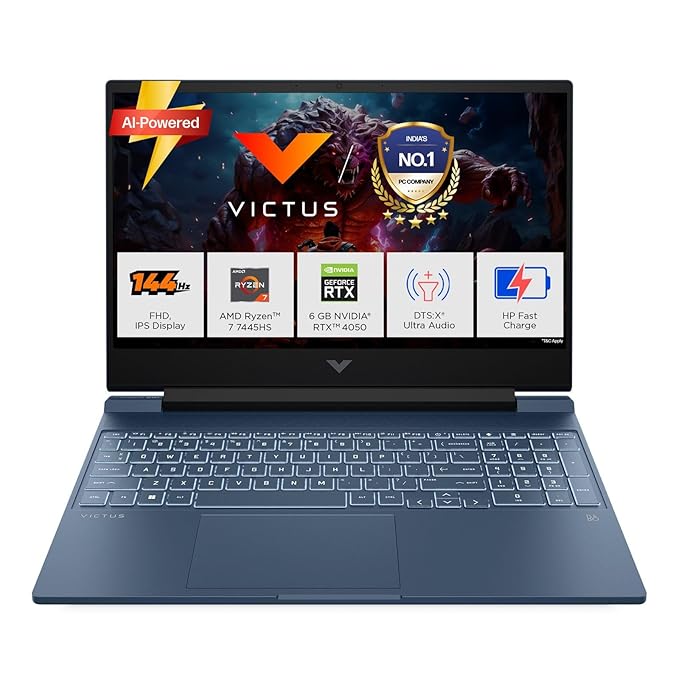
HP Victus 15 (Ryzen 7 7445HS, RTX 4050 6GB, 16GB, 512GB)
Best AMD value under 1 lakh in 2026 stock. Zen 3+ Ryzen 7 plus RTX 4050 for Unity 3D and light Unreal.
Rs 90,990 Price as of 2026 (confirm live)
3. Lenovo LOQ 2024 (Unity sweet spot, Rs 1,02,053)
The Lenovo LOQ 2024 with the Intel Core i5-13450HX and RTX 4050 6 GB is the most balanced laptop in this price range for game dev. The HX-class CPU is a desktop-grade 10-core, 16-thread part, a real jump over the H-class chips in the entry tier. Unity script recompiles drop from 6 to 7 seconds to under 4 on a medium project. Unreal Engine 5 first-time shader compile is around 18 minutes on Lyra, workable. RAM is 16 GB DDR5 5200 with one free slot, SSD is 512 GB Gen 4. The 15.6-inch 144Hz IPS panel covers 100 percent sRGB on the better SKU. The price has crept up to just over a lakh in 2026 versus the sub-80k it sat at when the LOQ launched, but the HX-class CPU still justifies the spend over the Victus for anyone doing heavy Unity work.
Cooling is the LOQ’s quiet strength. Lenovo’s Coldfront design holds the CPU under 90 degrees and the GPU in the low 80s during sustained Unity light bakes, even in a hot room. The chassis is more rigid than the Nitro V, the trackpad is larger, and the keyboard has a proper number pad. Battery is around 5 hours on light coding work. For other RTX 4050 options at this price, the gaming laptops under 80,000 guide covers them in detail.
Pros: HX-class 10-core CPU, 100 percent sRGB on the upper SKU, excellent thermals, free RAM slot, large trackpad.
Cons: Webcam is poor for Discord calls, fan noise still audible during long bakes, no card reader, charger is bulky.
Who it is for: Unity indie devs shipping mobile or PC titles, students moving from prototype to production, anyone who wants one laptop that handles Unity work and Valorant on the same day.
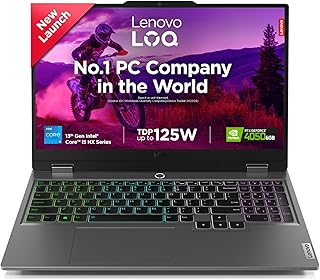
Lenovo LOQ 2024 (i5-13450HX, RTX 4050 6GB, 16GB, 512GB)
HX-class desktop-grade CPU plus RTX 4050. The balanced Unity pick for serious indie work.
Rs 1,02,053 Price as of 2026 (confirm live)
4. ASUS TUF Gaming A16 (all-day editor pick, Rs 1,08,990)
The ASUS TUF Gaming A16 2026 model ships with a current Ryzen 7 mobile chip (Amazon’s listing uses non-standard naming, so we are not citing a specific SKU number) and the RTX 4050 6 GB. The 2024 SKU with the Ryzen 7 7735HS plus RTX 4060 has sold through Indian stock. The GPU step-down from 4060 to 4050 is real, but the value-add at this price is the 16-inch FHD+ IPS panel, the 1 TB SSD out of the box, and the free SO-DIMM slot for a 32 GB upgrade. For UI work, texture tweaking, and shader graph editing, the extra vertical room versus a 15-inch panel changes the day. The chassis is MIL-STD-810H rated and the keyboard deck is firm.
Thermals are where the TUF A16 wins long bakes. The dual heat-pipe array with liquid metal on the CPU holds sustained Unreal shader compile temperatures at around 88 degrees CPU and 78 GPU, even with ambient at 33 degrees Celsius. Fans get loud, but the laptop does not throttle. Battery is roughly 6 hours on light coding. The downside is weight at 2.2 kg and a bulky 240W charger.
Pros: 16-inch FHD+ IPS display, 1 TB SSD out of the box, MIL-STD chassis, excellent thermals, free RAM slot for 32 GB upgrade.
Cons: RTX 4050 over 4060 versus the 2024 SKU, 2.2 kg weight, large charger, fan noise under load, webcam still mediocre.
Who it is for: Indie devs and small studios spending 8 hours a day in the editor, anyone who values display real estate, developers shipping 3D Unity or light Unreal titles for PC.
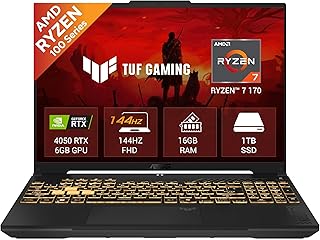
ASUS TUF Gaming A16 (Ryzen 7 2026 mobile, RTX 4050 6GB, 16GB, 1TB)
16-inch panel, 1 TB SSD, MIL-STD chassis, free RAM slot. The all-day editor laptop.
Rs 1,08,990 Price as of 2026 (confirm live)
5. ASUS ROG Strix G16 (top-end Unreal pick, Rs 1,84,990)
For serious Unreal Engine 5 work with Nanite, Lumen, and hardware ray tracing in editor previews, the ASUS ROG Strix G16 with the AMD Ryzen 9 8940HX and RTX 5060 8 GB is the realistic ceiling in 2026 Indian stock. The 2024 i7-13650HX plus RTX 4070 build that sat at Rs 1,44,990 has rotated out, replaced by this stronger but pricier configuration. The 8940HX is a Zen 4 16-core, 32-thread HX-class part, a step above the 14-core 13650HX it replaces. The RTX 5060 mobile at 115W TGP lands roughly at RTX 4060 Ti performance, so GPU lightmass and Lumen previews are faster than the 4070 mobile in many real workloads. The 16-inch 2.5K QHD+ IPS panel keeps the colour-accurate workflow story intact for anyone shipping to console or calibrated PC monitors.
The Strix G16 ships with 16 GB DDR5 in two slots, so a 32 GB upgrade means swapping both sticks. SSD is 1 TB Gen 4 with a free second M.2 slot. Cooling is the most aggressive of the five laptops here, with a vapour chamber and tri-fan layout that keeps the RTX 5060 at full power for hours. Fans are loud, but you can dial them in Armoury Crate. Weight is around 2.5 kg, charger is 280W, battery 4 to 5 hours. This is a desk laptop, not a travel laptop. The price jump to Rs 1,84,990 is steep, so only buy it if Unreal Engine 5 production work is paying your bills.
Pros: Zen 4 16-core HX CPU, RTX 5060 with 2026-gen features, 2.5K QHD+ panel, vapour chamber cooling, free second M.2 slot.
Cons: Both RAM slots filled (upgrade requires swapping), around 2.5 kg weight, 280W charger, Rs 1,84,990 puts it 40k above the 2024 top-end price.
Who it is for: Serious indie devs and small studios in Unreal Engine 5, anyone working with Nanite scenes, developers who need editor previews to stay smooth at QHD+.
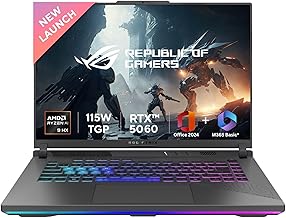
ASUS ROG Strix G16 (Ryzen 9 8940HX, RTX 5060 8GB, 16GB, 1TB)
16-core Zen 4 HX CPU plus RTX 5060 and 2.5K QHD+ panel. The realistic top end for Unreal Engine work.
Rs 1,84,990 Price as of 2026 (confirm live)
Full comparison table
| Laptop | CPU | GPU | RAM | SSD | Display | Price |
|---|---|---|---|---|---|---|
| Acer Nitro V 15 | Ryzen 5 6600H | RTX 3050 6GB | 16 GB DDR5 | 512 GB NVMe | 15.6 in, 144Hz IPS | Rs 74,990 |
| HP Victus 15 | Ryzen 7 7445HS | RTX 4050 6GB | 16 GB DDR5 | 512 GB NVMe | 15.6 in, 144Hz IPS | Rs 90,990 |
| Lenovo LOQ 2024 | i5-13450HX | RTX 4050 6GB | 16 GB DDR5 | 512 GB NVMe | 15.6 in, 144Hz IPS | Rs 1,02,053 |
| ASUS TUF Gaming A16 | Ryzen 7 (2026 mobile) | RTX 4050 6GB | 16 GB DDR5 | 1 TB NVMe | 16 in, FHD+ IPS | Rs 1,08,990 |
| ASUS ROG Strix G16 | Ryzen 9 8940HX | RTX 5060 8GB | 16 GB DDR5 | 1 TB NVMe | 16 in, 2.5K QHD+ | Rs 1,84,990 |
Setup tips for game dev workflows on a laptop
A few setup choices save hours every week. First, for Unity, install Visual Studio Community 2022 instead of VS Code. The Unity integration handles asmdef projects properly, IntelliSense actually finds your MonoBehaviour types, and debug attach is one click. VS Code with the C# extension is fine for Godot scripting, but for Unity it costs you compile-cycle speed.
Second, for Unreal Engine, never put the engine install and your project on the same partition as Windows. The first-time shader cache alone is around 40 GB. Use the boot SSD for OS and Visual Studio, and a second NVMe (internal if your laptop has a free slot, external USB 3.2 Gen 2 enclosure otherwise) for the Unreal install and all projects. A 1 TB external NVMe in a Gen 2 enclosure costs around Rs 6,500 in 2026 and is the single best money you will spend.
Third, learn the thermal control software. Armoury Crate on ASUS, Lenovo Vantage on LOQ, NitroSense on Acer, OMEN Gaming Hub on HP. Set a custom fan curve that ramps earlier than default. Default profiles are tuned for short gaming bursts, not sustained compile loads. Getting fans to 70 percent at 70 degrees instead of 80 keeps the CPU from throttling on long Unreal bakes. The saving on a 30-minute shader compile is around 90 seconds, which adds up.
Fourth, an external monitor is not optional once your project gets serious. A second 24-inch 1080p monitor for Rs 8,000 turns a laptop into a real dev station. The complete gaming setup under 1 lakh guide covers the wider peripheral ecosystem. Fifth, plug in. Every gaming laptop here throttles CPU and GPU on battery. Compile work on AC power is up to 40 percent faster.
FAQ
Do I need an RTX GPU for Unity? For 2D Unity or simple mobile games, no. Iris Xe or Radeon 780M integrated graphics will run the editor. The moment you use URP or HDRP with baked lighting, an RTX card cuts bake times from 30-plus minutes to under 5. RTX 3050 is the realistic floor for 3D Unity work.
Will integrated graphics work for Godot? Yes, for 2D and light 3D. Godot 4.3 with Forward+ on a Radeon 780M iGPU runs sample 3D scenes at 50 to 60 FPS at 1080p. You will hit limits with lots of dynamic lights or complex shaders, but for most indie Godot work an iGPU is workable.
Mac vs Windows for Unreal Engine in India? Windows wins at every price point. Unreal Engine 5 on macOS is a second-class citizen, Apple Silicon mobile GPUs lag Nvidia in shader compile, and Macs that compete on raw performance cost over Rs 2,00,000. For Unity and Godot, M-series MacBook Air or Pro are competitive, but you lose ARCore tooling and some Android profiling features.
Is 16 GB RAM enough for game dev? For Godot and basic Unity, yes. For Unreal Engine 5 or a Unity project crossing 5 GB on disk, 16 GB is the floor and you will hit swap. Plan for 32 GB if you are serious. The HP Victus, Lenovo LOQ, and ASUS TUF A16 all have free SO-DIMM slots, so a Rs 3,500 upgrade doubles your RAM later.
What about ARM laptops like Snapdragon X Elite? Skip them for game dev in 2026. Unity supports Windows on ARM only experimentally, Unreal has no production-ready ARM build, and most Android emulators run slowly on ARM Windows. They are fine for 2D Godot and pure scripting, not full engine work.
Should I build a desktop PC instead? If you are home-based and do not need portability, a desktop at the same budget gets you roughly 30 percent more performance. A gaming PC build under 50,000 plus a monitor often beats a laptop on pure compile and bake numbers. The trade-off is portability. For hostel students or cafe workers, the laptop wins.
How long should this laptop last me? Plan for 4 to 5 years of useful life if you upgrade RAM to 32 GB and add a second SSD by year two. The CPU and GPU in the LOQ or Victus will run Unity and Unreal projects through 2030, though not with top engine features by then.
The bottom line by budget
Under Rs 80,000, get the Acer Nitro V 15. It is the only laptop that lets you start real Unity 3D work at this price, and the free RAM slot means a Rs 3,500 upgrade later doubles your headroom.
Between Rs 80,000 and Rs 1,00,000, the HP Victus 15 with Ryzen 7 7445HS and RTX 4050 is the AMD value pick. Buy this if Unity 3D and light Unreal are your main workload and you want a Zen 3+ Ryzen 7 under a lakh.
At Rs 1,00,000 to Rs 1,10,000, the Lenovo LOQ 2024 with the i5-13450HX HX-class CPU is the Unity sweet spot. The 10-core HX part is a real jump for script recompile and Android build times, and the LOQ’s Coldfront cooling holds up in Mumbai summer.
Between Rs 1,10,000 and Rs 1,50,000, the ASUS TUF Gaming A16 is the all-day editor laptop. The 16-inch FHD+ panel and the 1 TB SSD out of the box justify the jump from the LOQ for anyone who spends most of the day inside an engine editor.
At Rs 1,50,000 to Rs 1,85,000, the ASUS ROG Strix G16 with the Ryzen 9 8940HX and RTX 5060 is the ceiling. Buy it only if you are paid to ship Unreal Engine 5 work, or if you are a small studio outfitting developers. For everyone else, the TUF A16 is the smarter buy. Prices were checked against Amazon.in in 2026 and shift during sales. Confirm the live price on the Amazon listing before you buy.