
Updated September 2026 with current Indian retail prices.
Four decisions set the price of a gaming monitor in India: resolution, refresh rate, panel type and size. Everything else on the spec sheet is noise or marketing. Below is what each decision actually costs at Indian prices checked on Amazon.in in September 2026, which ones you will notice while playing, and which ones you will not.
The short answer
- Most people: 24-inch, 1080p, 144Hz or better, IPS. Around ₹10,000 to ₹12,000.
- If you can stretch: 27-inch, 1440p, IPS. Around ₹16,000. This is the single biggest visible upgrade.
- Skip 4K for gaming unless your GPU is genuinely high end. The cheapest 4K gaming panels start near ₹38,000 and your frame rate pays for it.
Monitor spec sheets are written to make every panel sound like a competitive advantage. In practice, four things decide whether you enjoy a monitor, and three or four more exist only to justify a price. This guide goes through them in the order that actually costs money in India, using prices read from live Amazon.in listings in September 2026 rather than launch prices or US conversions.
1. Resolution: the one that changes what you see
Resolution is how many pixels the panel has. 1080p (1920×1080) is the Indian default and what almost every sub-₹13,000 monitor uses. 1440p (2560×1440, also called QHD or 2K) has roughly 78 percent more pixels, which on a 27-inch panel is the difference between text and edges looking soft and looking sharp. 4K (3840×2160) is sharper again, and far more expensive to actually drive.
The part most buying guides skip: resolution interacts with size. A 24-inch 1080p panel and a 27-inch 1440p panel have almost the same pixel density, so both look sharp. A 27-inch 1080p panel does not, because the same pixels are stretched over more area. If you are buying 27-inch, budget for 1440p. If your budget caps at 1080p, buy 24-inch and put the saving elsewhere.
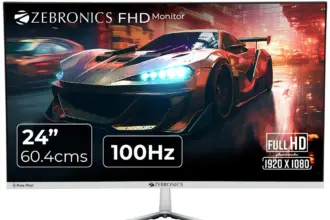
What this costs in India right now: a 24-inch 1080p IPS gaming panel sits around ₹10,300, a 27-inch 1440p IPS around ₹16,000, and the cheapest 4K gaming panels start near ₹38,700. The jump from 1080p to 1440p costs roughly ₹6,000 and is the most visible upgrade on this page. The jump from 1440p to 4K costs roughly ₹22,000 more and needs a much stronger GPU to use.
2. Refresh rate: the one you feel rather than see
Refresh rate is how many times per second the panel redraws, measured in Hz. A 60Hz panel redraws 60 times a second; a 144Hz panel 144 times. The difference between 60Hz and 144Hz is immediately obvious in motion, in a way screenshots cannot show. Moving your mouse across the desktop feels different.
144Hz is the floor worth buying in 2026. It costs almost nothing over 60Hz at this point, and in India you will struggle to find a gaming panel below it. Above 144Hz the returns fall off sharply: 165Hz over 144Hz is a rounding error, and 240Hz only pays off if you play competitive shooters seriously and your PC can actually push 240 frames per second in them.
The honest test: check what frame rate your PC produces in the games you actually play. If BGMI, Valorant or CS2 run at 200-plus frames, a 240Hz panel is doing something for you. If your RTX 3050 laptop produces 90 frames in the games you care about, a 240Hz panel is decoration and a 144Hz panel plus a resolution upgrade is the better spend.
3. Panel type: IPS, VA or TN, and why the answer is usually IPS
IPS gives the best colour and the widest viewing angles, and modern IPS panels are fast enough that the old “too slow for gaming” objection no longer applies. VA gives deeper blacks and higher contrast, which looks better in dark games and films, but can smear in fast dark scenes. TN is the oldest type: fastest and cheapest, with visibly worse colour and angles.
For nearly everyone the answer is IPS. Buy VA if you mostly play atmospheric single-player games in a dark room and care about contrast more than colour accuracy. Buy TN only if you are on a strict budget and refresh rate matters more to you than how the screen looks, which is a narrow case in 2026.
4. Size, and the thing Indian desks get wrong
24-inch and 27-inch cover almost every sensible choice. 32-inch and above only makes sense at 1440p or 4K and at a viewing distance most Indian desks do not have. Measure the distance from your eyes to where the screen will sit. Under about 60cm, a 27-inch panel means moving your head to track the edges, which gets tiring.
Curved panels are the most oversold feature in this category. On a 27-inch monitor the curve is mild enough that most people stop noticing it within a day. It is not a reason to pay more, and it is not a reason to avoid a monitor either.
The specs you can safely ignore
“1ms response time”. Almost every gaming monitor claims it, measured in a best case mode that often introduces visible overshoot. It is close to meaningless as a comparison between two modern panels.
HDR under ₹30,000. Real HDR needs sustained brightness and local dimming. Budget panels carry an HDR10 logo and a peak brightness that cannot deliver it, so the mode usually makes games look washed out. Leave it off.
Speaker quality. Built-in monitor speakers are uniformly bad. Treat them as an emergency backup, not a feature you pay for.
G-Sync versus FreeSync. Adaptive sync stops screen tearing and is genuinely worth having, but the branding no longer matters much: most FreeSync monitors work with NVIDIA cards. Check the monitor supports adaptive sync at all, then stop worrying about which logo it carries.
Three things that only matter in India
Warranty and service network. A dead pixel policy and a service centre you can reach matter more than a spec you will never measure. Acer, LG and Samsung have the widest service coverage here. Check the warranty is India-specific and not an international one you cannot claim.
Grey imports. A price noticeably below every other listing for the same model usually means an imported unit with no local warranty. The saving disappears the first time you need service.
Stock volatility. Gaming monitor pricing in India moves week to week, and listings go out of stock without warning. Whatever you read here or anywhere else, confirm the price and availability on the live listing before you buy.
What each tier costs today
Prices read from live Amazon.in listings in September 2026. They move, so check the link.
| Budget | What it buys | Who it is for |
|---|---|---|
| Around ₹10,000 | 24-inch, 1080p, IPS, 144Hz or better | Most people, and anyone gaming on a laptop GPU |
| Around ₹16,000 | 27-inch, 1440p, IPS | The best value jump on this page, if your GPU can drive it |
| Around ₹38,000+ | 27-inch, 4K | High-end GPUs only, and content work more than gaming |
If you want specific models at each of these tiers, with prices and stock checked the same way, see our best gaming monitors in India guide.
Frequently asked questions
Is 1440p worth it over 1080p in India?
On a 27-inch panel, yes, and it is the most visible upgrade you can buy. The gap is roughly ₹6,000 at current prices. On a 24-inch panel the difference is much smaller, so 1080p is fine there.
Do I need more than 144Hz?
Only if your PC actually produces more than 144 frames per second in the games you play, and you play competitively. Otherwise the money is better spent on resolution or panel quality.
IPS or VA for gaming?
IPS for most people. VA only if you mostly play dark, atmospheric single-player games and value contrast over colour accuracy.
Is a curved monitor better for gaming?
Not meaningfully at 27 inches. It is a preference, not an upgrade, and not worth paying extra for.
Should I buy 4K for gaming?
Only with a genuinely high-end GPU. The cheapest 4K gaming panels in India start near ₹38,700, and driving 4K at a high frame rate costs far more in GPU than the monitor does.
Does HDR matter on a budget monitor?
No. Below roughly ₹30,000 the HDR badge is a logo rather than a capability, and enabling it usually makes games look worse.
G-Sync or FreeSync?
Either. Confirm the monitor supports adaptive sync, then ignore the branding. Most FreeSync panels work fine with NVIDIA cards.
What size monitor for a normal Indian desk?
Measure eye to screen distance. Under about 60cm, 24-inch is more comfortable. Above that, 27-inch at 1440p is the sweet spot.